
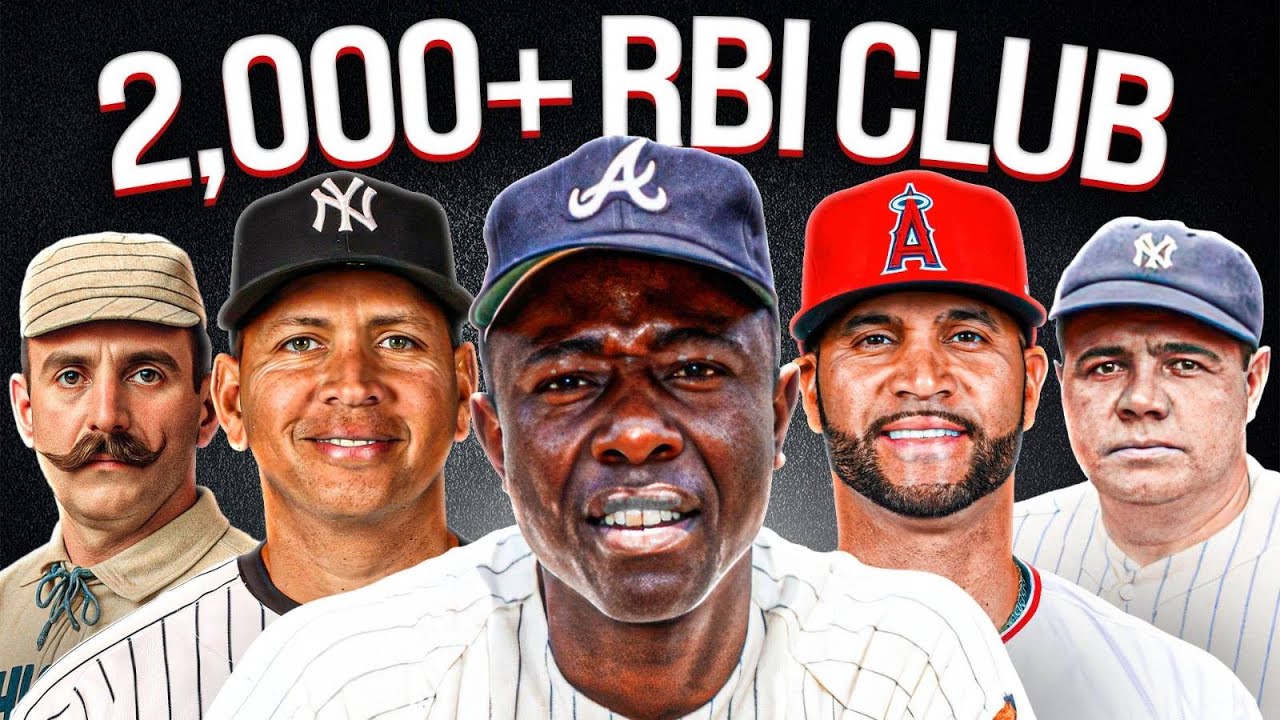
2000打点以上を記録した唯一の5人の打者
MLB history is filled with thousands of players. Yet, amidst its over a century and a half of existence, only a select few batters have ever stuck around long enough to knock in over 2,000 runs. In order of the rank on the all-time RBI list, these are the only five players to ever join the 2K RBY Club. Starting with the fifth man on the totem pole, who might just be the most iconic of them all. In the 19th century, before box scores filled newspapers and before baseball became America’s pastime, Adrien Cap Anson was already a star. A tall, imposing first baseman from Iowa, Anson spent nearly three decades shaping the Chicago White Stockings into a powerhouse. He wasn’t just their best hitter. He was their captain, their manager, and eventually their identity. Chicago fans called them Anson’s Colts, a reflection of how much the game revolved around him. He was among the first to bring strategy to baseball, experimenting with signals, rotating pitchers, and drilling fundamentals long before they were common place. And when it came to hitting, he was relentless, posting a career batting average above 330 and becoming one of the first players to surpass 3,000 hits. But his story is more complicated than that. Anson’s refusal to take the field against black opponents contributed to baseball’s early segregation, casting a long shadow over his otherwise glittering resume. Still, for better or worse, he was the sport’s first true superstar. And when the dust of the 19th century settled, no one had driven in more runs than Cap Anen, whose 2075 RBI’s stood as the benchmark for generations to come. One that only a modern-day lightning rod had the talent to beat. Now he hits a deep drive straightaway center field and gone. Alex Rodriguez was destined for baseball stardom before he could even drive a car. Drafted first overall by the Seattle Mariners at just 18, he stepped into the big leagues with skyhigh expectations. By his early 20s, he wasn’t just living up to the hype. He was rewriting what a shortstop could be. Tall, powerful, and athletic, A-Rod blended gold glove defense with middle of the order thunder, a combination the game had never seen. In Seattle, he was electric. By 1996, his first full season, he had 358 with 36 home runs and 123 RBI’s. It was the kind of breakout that made front offices salivate, which he paired with an even more insane season in 1998 as the third member of the coveted 40 homer 40 stolen base club. By 2001, the Texas Rangers handed him a record shattering $252 million contract, expecting him to carry their franchise. While the team struggled, Rodriguez did his part, winning an MVP in 2003 and putting up video game numbers year after year. But it was in New York where his career reached its most dramatic highs and lows. As a Yankee, he was at the center of constant media storms, a polarizing figure in pinstripes. Yet between the headlines, he produced seasons few could rival. In 2007, he crushed 54 homers and drove in 156 runs, winning his third MVP award. He delivered in October, too. Most memorably in 2009 when his clutch homers helped lead the Yankees to a World Series title. His steroid scandal nearly derailed everything though. His 2014 suspension was a major low point. The longest suspension in MLB history, a season essentially wiped away amid endless scrutiny. But when he returned, fans still saw the same dangerous swing and the same ability to punish mistakes. Through it all, Rodriguez’s story is one of contradictions. adored and despised, dominant and disgraced, yet always undeniable. By the time he retired in 2016, he had amassed 696 home runs and secured his place in history with 286 RBI’s, one of only five players to ever cross the 2000 mark. It doesn’t take controversy to build a 2000 RBI legacy, though, because an iconic man from the 1900s did it all with a squeaky clean record and a beer belly that could put your uncle to shame. Babe Bruce was the Sultan of SWAT. He was past his peak. But in the very first All-Star game, he came to bat with one man on and with poetic justice pulled a home run to provide the winning margin. When Babe Ruth arrived in the majors, he was just a left-handed pitcher with a powerful arm and a dream. But the moment he was given a chance to hit every day, baseball was never the same. His bat didn’t just clear fences. It changed the way the game was played, shifting it from small ball strategy to sheer power. Ruth’s rise with the New York Yankees turned him into an icon, bigger than the game itself. In the 1920s, while America was roaring, Ruth was its headliner. Fans poured into Yankee Stadium, the house that Ruth built, to see towering blasts that defied belief. He wasn’t simply hitting more home runs than anyone else. He was outpacing entire teams. But beyond the home runs was Roose’s uncanny knack for driving in runs. His presence in the lineup made the Yankees a juggernaut. And he delivered with bases loaded with runners in scoring position with the game on the line. You name it, he delivered. Seasons like 1921 when he knocked in 171 RBI’s were almost routine for him. Yet they were insane compared to his competition. His swagger, calling shots and drinking like a medieval king, and living larger than life made him both a legend and a spectacle. Ruth became the blueprint for what a superstar could be. Kids imitated his swing in sandlots. Adults debated his greatness, and baseball as a whole became a national obsession because of it. And while his 714 home runs may be his most famous stat, it was his relentless ability to bring runners home that solidified his place among the greats. By the end of his career, Babe Ruth had 2,214 RBI’s, a total that stood unmatched for nearly four decades. Joining the 2000 Riby Club doesn’t require a parters’s lifestyle, though, because while Babe was out drinking on the town, he was surpassed by a man so serious at the plate. All he could be referred to was the machine. The next Albert lifts it in the air out to deep right at the wall. Gone. X94. When Albert Pools made the St. Louis Cardinals roster as a 21-year-old rookie, few could have predicted what was coming. Because by the end of the first year, 37 homers, 130 RBI’s, and a Rookie of the Year award later, fans quickly realized they were watching the birth of something truly special. Over the next decade, Puls became a model of consistency. He didn’t have Ruth’s flamboyance or Rodriguez’s drama. He was quiet, disciplined, and devastating at the plate. But from 2001 to 2011, he hit like nobody else ever had in history. He averaged 40 home runs and 121 RBI’s, all while hitting over 320. Cardinals fans nicknamed him the machine because his production seemed mechanical and almost inevitable. In St. Louis, he wasn’t just a stack compiler, he was a champion. GS delivered in October, winning two World Series titles and producing one of the most iconic postseason moments in 2005 when he sent a Bradlledge pitch deep into the Houston night. His ability to rise when it mattered most made him not only respected, but feared. The second act of his career with the Los Angeles Angels was quieter, but still insane. Even as his batting average dipped, the RBI’s kept piling up. In 2016, at age 36, he knocked in 119 runs, proof that his run producing instincts never faded. His final stop back in St. Louis brought a storybook ending. Cappy is 700th career home run in 2022. What made Puls remarkable wasn’t just the power, but the reliability. He had 14 seasons of 100 plus RBI’s across two decades. When he finally retired, his RBI total stood at 2,218, second only to one man. That man, of course, was Hank Aaron, the gold standard of longevity, excellence, and resilience. Once again, a standing ovation for Henry Aaron. Hank Aaron’s path to baseball immortality began in Mobile, Alabama, where he grew up poor and swinging at bottle caps with makeshift bats. By the time he debuted with the Milwaukee Braves in 1954, his swing, compact, quick, and powerful, was already unmistakable. Aaron never sought the spotlight, but the numbers wouldn’t let him hide. Year after year, he quietly stacked one great season onto another. He wasn’t a slugger who hit 60 in a season. His careerhigh was 47. Instead, he was the model of steady brilliance, hitting 30 to 40 homers every year while also driving in a 100 runs and batting over 300 like clockwork. By the 1960s, he’d established himself as the most reliable force in the National League. The pinnacle came in the 1970s when he began chasing Babe Ruth’s home run record. With every swing, he drew closer not just to history, but into the crosshairs of hate. Aaron received thousands of racist letters and death threats as he neared 714, carrying a burden that went far beyond the ballpark. Yet, he never flinched. On April 8th, 1974, he hit number 715. Passing Ruth and cementing his place as the all-time home run kick. Lost in the shadow of that milestone was his other towering achievement, run production. Aaron drove in a hundred or more runs in 11 different seasons. He was a master at capitalizing on opportunities, whether it was a single to write or a towering shot into the seeds. Unlike others who peaked briefly, Aaron’s greatness lasted more than two decades. His 23-year career produced 3,771 hits, 755 home runs, and the ultimate RBI record, 2,297, a number no player has ever matched. Aaron’s legacy is not only in the numbers, but in his dignity. He carried himself with grace through racism, scrutiny, and pressure. Leaving behind a standard that transcends baseball. From the first RBI Titan and Cap Anson to the relentless excellence of Hank Aaron, the story of run production is the story of baseball itself. A history written one swing, one clutch hit, and one RBI at a time. which is exactly why he is one of the only members of the 600 plus home run club. Watch this video to see which other superstars have joined baseball’s most exclusive powerhitting club.
Only five players in MLB history have ever crossed the mythical 2,000 RBI mark—and their stories span centuries, scandals, and staggering greatness. From Cap Anson’s 19th-century dominance to A-Rod’s controversial power, Babe Ruth’s larger-than-life legacy, and Hank Aaron’s unmatched consistency, this video dives into the elite few who turned clutch hitting into a career-defining art.
💻For Business Inquiries, Collaborations or Promotions, contact us at: battersboxchannel@gmail.com
#MajorLeagueBaseball #MLB #Baseball
NPBHUB.COM | The Fanbase of Nippon Baseball & Nippon Professional Baseball