
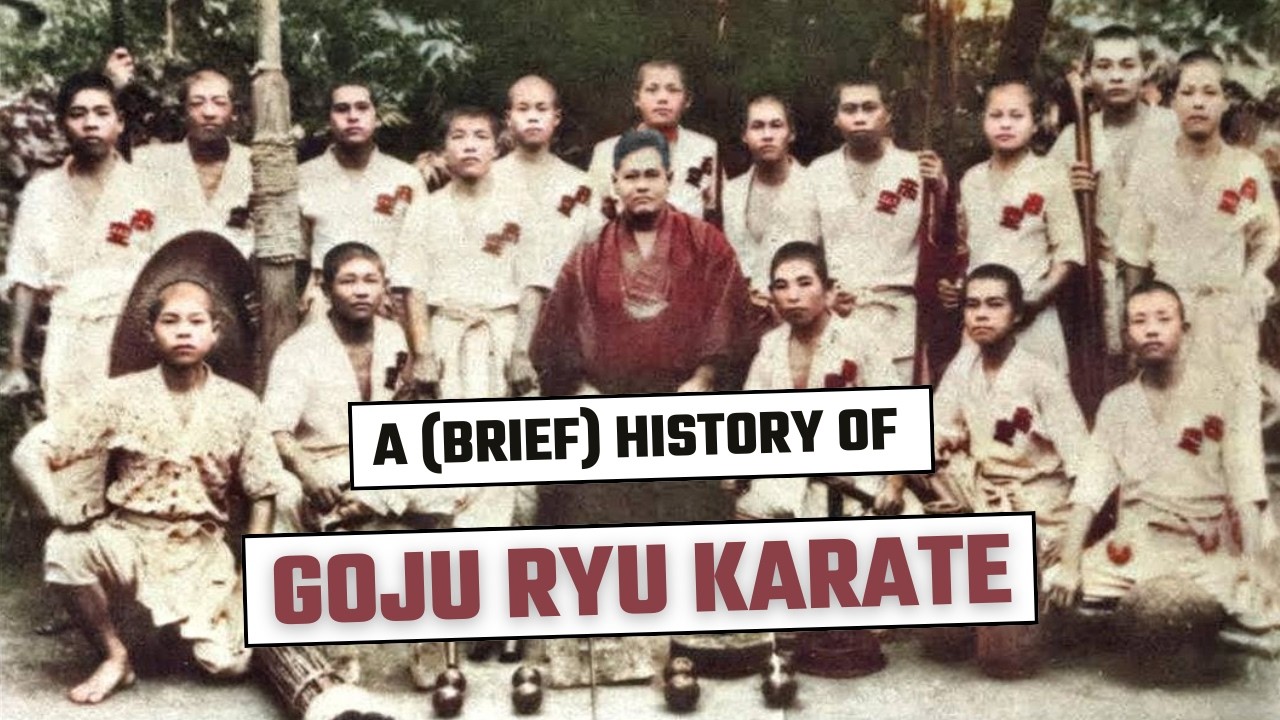
A Brief History of Goju Ryu Karate – Miyagi, Okinawa & Syllabus
Onegaishimasu, welcome back to the Goju Ryu Karate Center so I’ve been doing Goju Ryu for just short of 20 years now uh practicing it studying it teaching
it and I thought I’d take all the knowledge that’s in my head and distill it using my nerdy ways
to make an accessible intro to goju ryu karate given the incredibly complex history of Goju
Ryu I could easily do a 2hour video on this topic but for now we’re just going to talk about
what Goju Ryu is and what it isn’t where it comes from what it’s about and hopefully you will have
many more questions at the end that you can ask either me or your sensei about this beautiful art
let’s get started with the beginning Goju Ryu is a traditional Okinawan close-range martial art
that originated in Naha Okinawa. While karate is often seen as a Japanese invention it originated
in Okinawa but it was mostly exported to the world by the Japanese and with the help of American
soldiers returning from their stations in Okinawa and taking karate back to America with them and
thus um making it a global and popular activity i hate to call it sport what makes Goju Ryu such
a distinct style is its close-range nature its supplementary training and its combination of
circular and straight techniques it also has hoju undo it has bunkai, kakie, randori so it is
a large system and if taught properly it is also a complete system but we’ll get into that later
Goju Ryu was named the hard soft way in 1930 and the story goes that Jinan Shinzato who was Chojun
Miyagi’s top student at the time went to the all Japan demonstration for martial arts in Kyoto
and when he was asked by the organizers what the name of his style was he didn’t have a name so
on the spot he came up with Hanko-ryu which means half hard style and when he returned to Sensei
Miyagi Sense Miyagi realized he needed to give his own style that he created a name and so from
there he chose a line from the poem that’s in the Bubishi the eight precepts inhaling represents
softness while exhaling characterizes hardness it is this contrast of hard and soft straight
and circular that epitomizes Goju Ryu and makes it a distinct style Goju Ryu contains eight elements or
eight possible subjects and this is delineated by sensei Teruo Chinen we even have a board in the dojo
for it dojo kun which is the dojo which is philosophy, kokyo-ho, which is breathing work Jumbi undo, kiga undo and hojo undo which are different forms of supplementary training kata of course and bunkai and oyo including
basic and advanced which is oyo Kakie, kumite, dento and reikishi so uh dento and reikishi is history and respect, well basically manners. when you walk into a serious Goju Ryu dojo you should see training implements such as the kongoken, chishi, ishisashi, nigirigame and makiwara there are 12 kata two of which are only
found in Goju Ryu namely Shisochin and Tensho, you’ll see randori which is slow, controlled
and continuous fighting there’ll be kakie which is pushing hands technique and originates
from Chinese pakqua fighting Miyagi’s own cross study of judo and wrestling also adds flavor to the bunkai which has locks throws chokes and any number of strikes built in you can see the full
range of them in our bunkai playlist to get an idea and on the wall you should see a picture of
this man,Chojun Miyagi. Miyagi is probably the most famous name in karate thanks to the Karate Kid movies the character of Mr Miyagi was named for Chojun, as the script writer ofthe Karate Kid movies Robert Mark Caman practiced Goju Ryu he based the script on his own bullying story and
his two very different instructors as you can see in Kreese and Miyagi and the rest is history the real Chojun Miyagi was born as Miyagi Matsu in Naha in 1888 and was given the name Miyagi Chojun at the age of five when he was adopted by his uncle and aunt after the death of
his father details differ from account to account but he started training at the between 11 and 14
years old with Tomari-te master and fighter and conveniently his neighbor Ryoko Aragaki sensei
this is why you shouldn’t let anyone tell you the kids can’t do karate was good enough from
Miyagi When Aragaki sensei moved away to Taiwan Chojun sensei was then introduced to Kanryo Higaonna who he trained with until he passed away in 1916 after school each day Chojun Miyagi would run 10
km to his sensei’s house adding to his physical excellence with gymnastics and wrestling because
of Okinawa’s history as a trading post between Japan and China he drew many influences from not
only the instructors he trained with in Okinawa but in his travels to those countries which
include influences from White Crane Kung Fu, monk fist boxing and as well as To-de, which was the local
version of empty-hand fighting it’s important to note that luck played a large part in Goju Ryu’s
destiny Miyagi sensei’s family were in import export which means they had access to merchant ships
which meant he had access to travel to go and expand his studies by accounts of the time his
family was really rather wealthy and they were also very generous in that they bankrolled his
karate journey they paid for everything so that he could focus on karate because they saw his gift he
was able to quit his desk job and focus on karate and this is important to remember he was a trust
fund baby he was able to pursue his karate because it was paid for i want you to give yourself a
break because not everyone has these kind of circumstances that allows them to fully embody
karate it puts pretty much paid to the lie that karate was created uh by peasants which is unfair
and untrue it was used by fishermen and farmers and the working class but it wasn’t taught to them
and it wasn’t invented by them it was invented by Chojun Miyagi and Gichin Fukoshi and these
men who were of a higher social class and had more access to money and more time it’s hard to create
a martial arts style when you have to go fishing for 12 hours a day and still go look after your
family or when you or when you’re a farmer and you’re trying to get crops so karate may have
been practiced by the working class but it was created and grown by wealthier men i digress he spent much time traveling around China learning from whoever he could and especially in Fujian Province the home of White Crane Kung Fu which was created by a woman named Fang Jiaing I’m sorry
if I butchered the pronunciation but I’ll share her story in a whole other video he brought back his knowledge and started teaching his own style throughout the 1920s and 30s until the outbreak
of World War II in 1918 Chojun Miyagi worked with Choki Motobu Sensei Chomo Hanashiro Sensei and Kenwa
Mabuni Sensei to set up the Ryuku Tode Kenkyu Kai one of the first organizations for promoting Tode and
karate as well as doubling up as a research and knowledge preservation group i think that’s a good
idea i think we need to start these uh collective uh karate studying groups again and then Goju Ryu
was the first Okinawan style to be recognized by the Dai Nippon Butokukai in 1933 as with so many of these giants across history there are many apocryphal and anecdotal stories that we are lucky
to have through first person accounts through the diaries of his family and through the students
who managed to keep these stories and pass them on and that we still have access to through media
one of my favorite stories that I was told about him is that because he had moderate wealth he
would let the children in the neighborhood come and eat from his fruit trees for free um and
let themselves fill themselves up because he knew that not everyone had and we’ll talk about
Okinawa’s devastating poverty after the Second World War now now in an interview with his daughter she talks about how he was a very devoted, strict, but very devoted and loving father and every
Saturday he would bath them he would shampoo their hair and he would meticulously cut their
nails for them and then there’s also stories where he would rip bare meat with his hands
and one where he punctured a hole in a kerosene can with just his big toe and of course
the shredding the bamboo poles and defeating any number of challengers these are all part of the of
the mythmaking of uh Sensei Miyagi and of course with any kind of historical record it’s hard
to be sure what’s true and what’s been kind of uh blown up over the years but I do think it
captures kind of the essence of his character karate ground to a halt during the Second World
War on April 1st 1945 Okinawa became a theater of war caught between America and Japan in the
Battle of Okinawa also known as Operation Iceberg 1,780 Okinawan school boys aged between 14 and 17
were conscripted into battle by the Japanese in the Teketsu Kinotai or the Iron and Blood Imperial
Force 149,634 Okinawans died at least 90% of the buildings on the island were destroyed along with countless historical artifacts, documents, cultural treasures, and the tropical landscape was turned
into quote a vast field of mud lead decay and maggots end quote Chojun Miyagi lost many of his
students including his top student Jinan and three of his 10 children his books and scrolls were lost, his dojo was destroyed and was later only rebuilt by his students as the Jundokan or the
home of the father in his garden just before his death In an interview with Sensei Eiichi Miyazato
he said that quote “We had no water electricity and some families were without a home it was a
survival period where our primary concern was for our families and to provide food for them it was
not on karate.” Sadly before his style could grow Sensei Chojun Miyagi died from his second heart attack in 1953 i hope that wherever he is I hope when Sensei Miyagi in the big dojo in the sky I hope you
can see how his incredible style has flourished around the world from his little garden dojo in
Naha right to every nearly every continent right down here to South Africa to America to you name
it there’s very few countries that don’t have Goju Ryu I I hope he can see that success wherever he
is because this is a video for beginners I’m not getting into the very messy history of succession and lineage after sensei Miyagi died suffice to say there were multiple breakoffs there was one
meeting where a semi heir had been agreed upon but as with anytime there’s a death of a
major figure in any martial arts there is and always will be splits and sometimes they don’t
even have to wait for someone to die there will just be splits anyway there are creators who’ve done a deeper dive into the exact topic of Goju Ryu history post World War II i will link to
them in the description along with all the other references I’ve used for this video suffice to say
what you need to know as a beginner is that there are many schools and many offshoots of Goju Ryu
you can have an authentic lineage which is going back as far as possible directly to Chojun Miyagi
there are schools that have splintered off more recently and with martial arts as with anything
your mileage may vary it does remind me of a little bit of that scene from the life of Brian
for those of you who are old enough to get this reference where the one person’s like I’ve got
his shoe and I’ve got his gourd and he’s running around going I’m not the Messiah i feel like a
lot of that sums up the splits in karate in my opinion in my third Dan 19 years of karate, been
to Okinawa opinion Goju Ryu is a complete style whatever the MMA guys think they’re doing there’s
only so many ways to hit someone there’s only so many ways to do something and it’s all in Goju ryu if
you look at the complete system as it was taught back in the day we’ve got it we’ve got locks we’ve
got chokes we’ve got throws we’ve got stand up fighting we’ve got conditioning for strength we’ve
got conditioning for speed conditioning for power but and this is the caveat because it is such a
large system and such a deep and complex system it takes years and years of mastery there are
no shortcuts in Goju Ryu there’s no quick way to a black belt there’s no quick way to become
incredibly strong and incredibly powerful all the Goju Ryu power men have become that way through
many years of meticulous and consistent study so I think one of the reasons why Goju Ryu isn’t as
popular is because it’s not an easy style um yes there are one or two simple kata in terms of Geki
Sai Dai Ichi and Ni but after that the difficulty curve does become significantly harder and I think
in an age where people don’t necessarily have the time or the attention span or the bandwidth to
study for more than 6 months i think Goju Ryu is a very demanding very challenging style which
is why I love it I’ll never run out of things to learn and I’ll never run out of things to do and
that’s why I hope to continue training until, you know, it’s my turn to shuffle off this mortal coil
hopefully in my 80s or 90s because I’ve seen in Okinawa I’ve seen practitioners in their 60s ‘7s
and 80s some of them in their 80s are putting the 30-year-olds to shame in terms of their power
and their control and their and the grace with which they perform their kata I didn’t start Goju Ryu specifically though because it was Goju Ryu when I started karate at 19 when I found a little
dojo tucked away in behind a bathroom at Varsity um I couldn’t have told you the difference
between Shotokan and Goju Ryu or Kyokushin i just found a dojo that I liked and it happened
to be Goju Ryu but since 2006 I’ve lucked my way into being under the Sensei Eiichi Miyazato line through Jundokan and I’ve been across three different federations this is across 19 years of
training all my certificates trace back to him and I believe that that’s as authentic a lineage
as you can get these are just some of the things I’ve learned i hope you enjoyed this video i hope you found it useful i hope it helps you um interrogate where your karate comes from who
taught it who taught them why they taught it the context in which it came up um and that’s why
it’s so important to know your cultural history of whatever style you’re learning your understanding
of Goju Ryu is not complete until you understand the impact that war had on Okinawa or the
relationship between Japan China and Okinawa pre-World War II it’s all got something to do
with how the flavor developed in the style the influences the impact of the style and I hope this
video helps you get at least a little foothold or a little foot in the door by asking the right
questions not only of your sensei but of your federation or your style where does it come from
who taught it where did they come from what were their influences who did they teach it to all
of these things are important things to consider a when you’re choosing a style or b if you are
looking into your style and again I refer to the fact that karate has a very contentious history
and a lot of these things have been challenged and we don’t have a lot of primary sources especially
since so much of it was destroyed in the second world war when Okinawa was basically flattened so
what I do what I have tried to give you are some of the facts the verbal ver the ver what’s what’s
that English word now the verified facts of Goju Ryu I’ve put my references in the description
below I will also add a set list of books that I feel are essential reading for the Goju Ryu
practitioner read everything with an open mind but there’s a saying from Terry Pratchet that I
love um if you when your mind is too open people will insist on putting things in So do your own
research ask your seniors enjoy this journey it becomes better the more you know about it i
hope you found my little video useful thank you for watching all the way through to the
end this took a really really really long time to make so please if you enjoyed it please
hit like and maybe share it with a friend i’d appreciate that train with enthusiasm
train forever thank you very much sayonara [Music]
Goju Ryu is a complicated style, with a complicated history. But with her background in history and the patience to edit, Zoë has created a beginner’s guide to Goju Ryu – the origins of the style, the impact of World War 2, and why it is such a beautiful and special art.
Chapters:
00:00 – Intro
00:36 – What is Goju Ryu?
02:18 – The Hapo
03:22 – Who was Chojun Miyagi?
08:06 – Okinawa in WW2
10:48 – My emphatic opinion that Goju is a complete style
12:31 – How I found Goju Ryu
Videos regarding the succession debate:
@GojuRyuPhilosopher https://youtu.be/pr6cI2HTHYQ?si=2OUxBhco23cB0ATV
@ArtofOneDojo https://youtu.be/jolyGrH447g?si=b7iXVC-gscwRDPzU
Reading list:
– Goju Ryu Karate-do Desk Reference by John Paul Williams: https://amzn.to/3q66ctq
– Goran Powell – Chojun (https://amzn.to/3iJuJl4)
– Michael Clarke – The Art of Hojo Undo (https://amzn.to/2RTXK2g)
– Gogen Yamaguchi – Goju Ryu Karate-Do Kyohan (https://amzn.to/2Txy7Vm)
– The Bubishi by Patrick McCarthy https://amzn.to/4001eQC
– Lawrence Kane and Kris Wilder – The Way of Kata (https://amzn.to/2RUWoV0)
– Four Shades of Black by Gavin Mulholland – https://amzn.to/45FmvTB
– Teruo Chinen DVDs (his books aren’t in print, alas) https://amzn.to/44grvfW
References:
– https://gojuryu.network/2003/03/the-memory-of-my-father-chojun-miyagi-%e5%ae%ae%e5%9f%8e%e9%95%b7%e9%a0%86/
– https://seiikankempo.wordpress.com/2014/07/26/goju-ryu-history/comment-page-1/
– https://www.rememberingokinawa.com/page/1945_okinawa_scenes_1
– https://digital.library.manoa.hawaii.edu/collections/show/56/
– https://unwritten-record.blogs.archives.gov/2020/04/02/spotlight-battle-of-okinawa/
– https://www.oki-islandguide.com/history
– https://www.dark-tourism.com/index.php/okinawa
https://factsanddetails.com/asian/ca67/sub429/entry-5339.html
https://www.tamucc.edu/library/exhibits/s/hist4350/page/okinawa
https://okinawakanlisboa.blogspot.com/2016/01/chojun-miyagi-and-shodo.html
chrome-extension://efaidnbmnnnibpcajpcglclefindmkaj/https://1582128.169.directo.fi/@Bin/e0b51b45731f6b3324e864d3954ef3b4/1749722773/application/pdf/220856/Miyazato%20interview.pdf
https://www.facebook.com/media/set/?set=a.1491867047785082&type=3
https://www.dragon-tsunami.org/Dtimes/Pages/article21.htm
https://en.wikipedia.org/wiki/G%C5%8Dj%C5%AB-ry%C5%AB
Join this channel to get access to perks:
https://www.youtube.com/channel/UCy61L8jq6ugyEwGNwMdVZhA/join
Our videos are free, but not cheap to make! Please consider subscribing, and get new videos every Friday. We also have the option of Super Thank Yous, which is like a tip jar for creators like us. Think of it as buying a coffee for Zoe when she edits 😉
We’re also a TubeBuddy affiliate! We love Tubebuddy for helping us run our channel – try them out using our link: https://www.tubebuddy.com/GojuRyuKarateCentre
Find us online!
https://www.grkc1978.com/
https://www.facebook.com/GojuRyuKarateCentre
https://www.instagram.com/gojuryukaratecentre/
Mailbag: dojo@grkc1978.com
Video produced by:
Zoe Jagger-Hinis
https://zoehinis.com/
NPBHUB.COM | The Fanbase of Nippon Baseball & Nippon Professional Baseball