
![(From left to right) Orix and Ryoma Nishikawa players, Saitama Seibu and Manaya Nishikawa players [Photo: courtesy of the baseball team].](https://www.npbhub.com/wp-content/uploads/2025/06/i48BwllpoyevUvMT3KyRcRQpFCCcT4op1Ol3LWU5.jpg "Ryoma of Orix and Aiya of Saitama Seibu. A look at the changes in the two “Nishikawas” who are active in Pacific League | Pacific League")
Two players with the same surname are at the top of Pacific League hit rankings
オリックスの西川龍馬選手がパ・リーグの安打数で2位、埼玉西武の西川愛也選手が同1位と、同じ「西川」という名字を持つ2名の選手がランキングの上位を占めている。両選手ともに主要な打撃タイトルを獲得した経験はないだけに、今後の活躍次第では初戴冠の可能性も大いにあるはずだ。
今回は、西川龍馬選手と西川愛也選手がこれまで記録してきた指標に基づく、選手としての特徴について紹介。それに加えて、今季の両選手がどういった部分で進化を遂げているのかについても確認し、残るシーズンでのさらなる活躍にも期待を寄せたい。(※以下の成績は5月30日の試合終了時点)
With his aggressive batting skills, he has achieved consistent results on the professional stage.
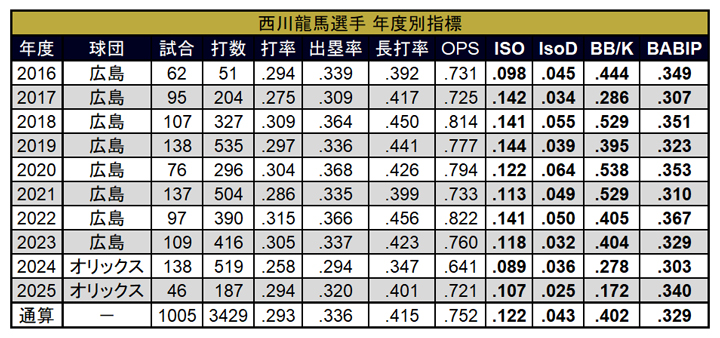
The annual indicators that Ryoma Nishikawa has recorded so far are as follows.
 Ryoma Nishikawa Annual Indicators ©PLM
His career batting average is .293, his career on-base percentage is .336, and his career average IsoD (the difference between batting average and on-base percentage) is a modest .043. These figures also show that Ryoma Nishikawa has achieved results on the professional stage through his aggressive batting style.
In addition, his career average BB/K, which is an indicator of batting eye like Walk (walks divided by struck out), is .402, which is not particularly high. After transferring to Orix in 2024, his BB/K will drop to .278, and in 2025, it will drop to .172, showing that he is more aggressive than ever in Pacific League and is not afraid of struck out.
He struggled in his first season in Pacific League last year, but this season he is back to his usual form.
Last season, his batting average of .258 and on-base percentage of .294 were both the worst in his career, and it was the first time in nine seasons that his on-base percentage was below .300. Furthermore, his slugging percentage also dropped significantly to .347, and his OPS also fell to .641, the first time in his career that it was below .600, and his productivity as hitter was also forced to decline.
However, if we look at the “BABIP,” which shows the percentage of batted balls in play that became hit, excluding Home Run runs, we can see a different side of things. BABIP is considered to be an indicator that is relatively dependent on luck, and the general standard value is .300.
Ryoma Nishikawa is left-handed hitter with speed, which is a trait that tends to favor him in terms of BABIP, and his career BABIP of .329 is well above the standard. However, his Ryoma Nishikawa in 2024 was .303, the worst in his career, suggesting that he was unlucky.
However, this season, his BABIP is .340, which is higher than his career average, and his batting average has risen to .294. Not only that, but his slugging percentage is .401 and hitter OPS is .721, which is close to his Hiroshima days, and this season is becoming a season where Ryoma Nishikawa ‘s true ability is being shown in many ways.
As for his “ISO,” which is said to be the “true slugging percentage” that excludes the influence of single hit, last season it was .089, the worst number of his career, but this season it has improved to .107. Since he hit 16 Home Run in 2019 and had three seasons in which he hit double-digit Home Run during his time with Hiroshima, we can expect him to further demonstrate his potential in terms of slugging in the future.
During the tough period when he went hit in consecutive at-bats, was there some bad luck involved?
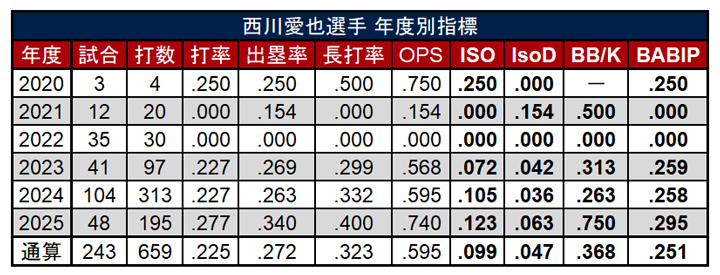
Next, let’s take a look at the annual indicators that Manaya Nishikawa has recorded so far.
 西川愛也選手 年度別指標 ©PLM
In 2020, his third year as a pro, he made his debut in the first team and recorded his first professional hit, but then went hitless for two consecutive years, struggling with a hit streak of 62 at-bats, the worst in the NPB for fielder. After stopping his record in 2023, he gradually increased his opportunities to play, but he still had issues with consistency, with a batting average of .227 for two consecutive years from 2023.
It is hard to imagine that Manaya Nishikawa ‘s struggles are unrelated to his BABIP. Manaya Nishikawa, a fast left-handed hitter, is generally considered to be the type of player who is likely to have an advantage in terms of BABIP. Despite this, Manaya Nishikawa ‘s career BABIP is .251, well below the standard value of .300.
In terms of his season-by-season numbers, he has been extremely unlucky in both of his two seasons since he established himself in the first team, hitting .259 in 2023 and .258 in 2024. However, his BABIP this season has improved to .295, close to the standard value, and his batting average has also shown a significant improvement to .277.
His batting eye and power hitting ability, which were issues for him, have improved, and he is showing great growth as hitter
In addition, his career IsoD is a modest .047, and just like Ryoma Nishikawa, he has a style of hitting good pitches at all costs. For an aggressive hitter, whether or not a ball that flies forward becomes a hit is a very important factor in terms of performance. It is only natural that the improvement in the BABIP of both players is directly linked to their good performance.
On the other hand, his career average BB/K was slightly lower at .368, but his BB/K in 2025 is showing a dramatic improvement to .750, second in the league. This season, his IsoD is also .063, well above his career average, showing a significant improvement in his batting eye and ability to control strike zone.
In addition, this season, his slugging percentage is .400 and his ISO is .123, both of which are significantly higher than his career averages, and he has improved not only his bat control but also his punch. Manaya Nishikawa has not only improved his BABIP, but has also made progress in indicators that are important in sabermetrics, such as his batting eye and slugging power, so there is a good chance that he will achieve even better results in the future.
Can he claim his first title?
Ryoma Nishikawa is getting closer to the form he was in his Hiroshima days, when he contributed to the team’s three consecutive Central League championships as a key player, while Manaya Nishikawa is evolving as hitter by improving his batting eye. Both players are characterized by aggressive batting styles, and as a result, an improvement in BABIP is directly linked to an increase in the number of hit. It is also interesting to note that there are quite a few similarities between the two players beyond their last names.
Both players, who are leading their teams in the top-ranking battle as chance makers, will be able to continue their sure-footed batting and win their first batting title. Why not keep an eye on the lively play of the two “Nishikawa” players who adorn Pacific League on both offense and defense for the rest of the season?
Written by Ryota Mochizuki
NPBHUB.COM | The Fanbase of Nippon Baseball & Nippon Professional Baseball