
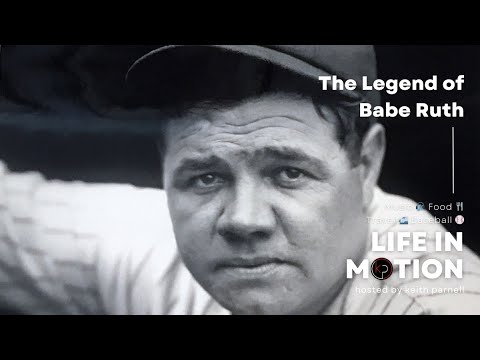
The Legend of Babe Ruth From Baltimore to Yankee Greatness
[Music] Babe Ruth. The name alone brings to mind towering home runs, sold out ballparks, and a legacy bigger than the game itself. But before the Sultan of SWAT became the most feared slugger in history, he was just a kid from Baltimore with a rough start and a gift for baseball. His story isn’t about the numbers. It’s about how one man changed the sport, captured the imagination of fans across generations, and became an American icon. Baseball has always had its heroes. Ted Williams was poetry in motion at the plate. Willie Mays played the game with a kind of joyful magic. Hank Aaron broke barriers with every swing of the bat. But Babe Ruth, he rewrote the rules entirely. He was a spectacle, a force of nature, the kind of legend whose name echoes through history. His journey wasn’t a straight shot to greatness. It started in the streets of Baltimore, wound through the strict walls of St. Mary’s Industrial School and took an un unexpected detour on the pitcher mound before he ever stepped into the batter’s box as a Yankee. To understand Babe Ruth, you have to go back to where it all began. Before the home runs, before the records, before he changed the sport forever. George Herman Ruth Jr. was a wild kid in a city that didn’t have room for wild kids. Born in 1895 to working-class parents who struggled to keep up with his rebellious streak, he was sent to St. Mary’s Industrial School for boys at just 7 years old. This wasn’t summer camp. It was a reformatory, a place for boys who needed discipline and direction. Ruth needed both. Enter brother Matias, a towering man with a firm but fair hand. He wasn’t just Ruth’s caretaker. He was his first real coach. The one who saw that beneath all that relentless energy was a natural ball player. Matias taught him how to swing, how to throw, how to think about the game. More importantly, he taught him structure, something Ruth had never known. St. Mary’s was where he learned to play baseball, but it was also where he learned how to channel his larger than-l life personality into something greater. Without those years under Brother Matias’s watchful eye, there’s no telling what path Ruth may have taken. Most people know Babe Ruth as the slugger who shattered records with his bat. But before he was rewriting history in the batters box, he was dominating from the pitcher mound. His left arm was a gift. And by the time he was a teenager, it was clear that he wasn’t just good, he was exceptional. Jack Dunn, the owner of the Baltimore Orioles, then a minor league team, saw Ruth pitch and knew he had something special. He signed him to a contract, becoming his legal guardian in the process since Ruth was still a teenager. That’s where the nickname Babe came from. He was the youngest on the team. Dun’s new project, the kid everyone called Dun’s Babe. By 1914, Ruth was in the big leagues. Pitching for the Boston Red Sox. He wasn’t just decent, he was dominant. He set a World Series record for consecutive scoreless innings, a mark that stood for decades. If his career had ended right then, he still would have been remembered as one of the best pitchers of his era. But fate had bigger plans. What happened next didn’t just change Babe Ruth’s career, it changed baseball itself. When the Boston Red Sox sold Babe Ruth to the New York Yankees in 1919, they gave up more than a pitcher. They handed over the future of the game. Ruth had already proven himself as a dominant arm on the mound, but New York saw something bigger. His bat had the power to reshape baseball itself. The Yankees moved him to the outfield, giving him freedom to focus on hitting. By 1920, he blasted 54 home runs, more than entire teams managed that season. Baseball had relied on strategy, small ball, and manufacturing runs. Ruth turned every atbat into a show, sending towering home runs into the stands with a swing that seemed effortless. Blleh. You can tell this is not a bot. Fans couldn’t get enough. The sports popularity exploded, attendance skyrocketed, and the demand for power hitting shifted the way the game was played. Babe Ruth didn’t follow baseball’s traditions. He rewrote them. Ruth’s arrival in New York created a baseball powerhouse. With him leading the charge, the Yankees built a dynasty, reaching a level of dominance that left opponents scrambling. The pinnacle came in 19 1927 with Murderers Row, a lineup so stacked with talent that pitchers struggle to find an escape. Earl Cololmes, Mark Koig, Babe Ruth, Lou Garri, Bob Musel, and Tony Lazeri. Every team had to prepare for Ruth, but few could stop him. His home run numbers soared and his impact reached beyond the scoreboard. Yankee Stadium opened in 1923 and it quickly became known as the house that Ruth built. The stadium it itself stood as a monument to the man who made baseball America’s game. Then came 1927, the season that defined his greatness. 60 home runs, a record that stood untouched for over three decades. The sheer force of that achievement sent a message to the world. Babe Ruth didn’t play baseball the way others did. He elevated it to something larger, something unforgettable. Babe Ruth’s impact goes beyond the highlight reels and mythical stories. The numbers tell their own story, one that cements his place as the most dominant force baseball has ever seen. 714 career home runs, 2,213 RBI’s, a 342 batting average, lifetime 342 batting average, a lifetime slugging percentage of 690, still the highest in history. Every one of these stats carries weight, but together they create a picture of a player who outclassed his era and set a standard that remains nearly untouchable. For those who analyze baseball through war, which is wins above replacement, Ruth’s dominance becomes even clearer. His career war sits at 182.6, a number that dwarfs the vast majority of Hall of Famers. It wasn’t just that he excelled. He created a gap between himself and the rest of the league that may never be matched. Ruth didn’t just hit home runs. He changed how offense was measured. Year after year, he led the league in on base percentage, slugging, and OPS categories that define offensive production in today’s analytics driven game. Even as baseball evolves, his stats remain the gold standard. Look at any modern superstar. Their numbers are often compared to Ruth’s not because they are expected to surpass them, but because he set the ultimate benchmark. His records didn’t fall easily, and many still stand strong, reinforcing that his greatness wasn’t limited to an era. It was built to last forever. Babe Ruth brought more than power to the plate. He brought spectacle. He turned baseball into entertainment, bridging the gap between athlete and celebrity before sports stars were global icons. Whether it was devouring hot dogs between innings, playfully winking at reporters, or stepping onto the field with a confidence of a man who knew he was the main attraction. Ruth understood the moment and owned it. Then came the 1932 World Series. The legend of calling his shot against the Cubs still sparks debate today, but the truth hardly matters anymore. That single moment with Ruth pointing toward the stands before launching a home run became a symbol of fearless showmanship, whether it happened exactly as the stories say or not. But for all his larger than-l life antics, there was a softer side. He never forgot what it was like to be a kid with no direction. Which is why he spent so much time visiting orphanages and hospitals, handing out baseballs, cracking jokes, and giving kids a moment of joy. To fans, he was a home run king. To those kids, he was something even greater. When the Baseball Hall of Fame opened its doors in 1936, there was never a question. Babe Ruth had to be in that first class. His name belonged in the history books. His story etched into the foundation of the sport itself. Decades later, his influence still echoes through baseball and beyond. From movies to video games, his legend endures. Even kids who have never watched a game know the name Babe Ruth before they can explain the infield fly rule. His greatness isn’t measured in stats alone. It’s in the way he captured imaginations generation after generation. Babe Ruth didn’t change baseball. He became baseball. When he stepped onto the field, the game felt bigger. The stakes felt higher. and every swing carried the weight of something unforgettable. He pulled the sport out of the dead ball era and sent it soaring into an age where home runs weren’t accidents. They were the main event. His numbers carve out a legacy few can touch. But Ruth’s impact can’t be measured in stats alone. He was more than a slugger, more than a record-breaker, more than a champion. He was a figure so legendary that even today his name sparks something in every baseball fan. A sense of history, of greatness, of the larger than-l life magic that makes this game special. If you love baseball, you can’t tell its story without him. Because Babe Ruth wasn’t just part of the game, he was the game. And in so many ways, he still is. That’s it for today’s episode of Life in Motion. If you like this, make sure to subscribe to my YouTube channel and follow me on Instagram for more real talk on music, food, travel, and baseball. Both links are available in the description below.
Babe Ruth. George Herman Ruth. It’s more than a name, it’s a baseball earthquake. I’ve spent years digging into the World of Baseball, and Ruth? He’s the center. It’s not just home runs. It’s a Baltimore kid, a pitcher turned legend, a force that changed the game.
Think about it. Before the Yankees, before the records, he was a dominant pitcher. Then, boom. The shift. The Yankees. Murderers’ Row. Babe Ruth rewrote the rules of baseball. Did you know the numbers still hold up? But it’s not just stats. It’s the impact he has on the game. The man, the myth, the legend.
I get into the story of Ruth, the real story. What made him so special? Was it his power? His personality? Maybe it was how he made baseball feel bigger. What do you think? Let’s talk baseball legends.
#WorldOfBaseball #KeithParnell #BabeRuth #SultanOfSwat #HomerunKing
📷 image credit: Charles M. Conlon, Public domain, via Wikimedia Commons
📷 image credit: Public domain, via Wikimedia Commons
📷 image credit: Frances P. Burke, Public domain, via Wikimedia Commons
📷 image credit: Underwood & Underwood, Public domain, via Wikimedia Commons
📷 image credit: Charles M. Conlon, Public domain, via Wikimedia Commons
📷 image credit: Bain News Service, publisher., Public domain, via Wikimedia Commons
📷 image credit: Public domain, via Wikimedia Commons
📷 image credit: Public domain, via Wikimedia Commons
📷 image credit: The Sporting News Archives, Public domain, via Wikimedia Commons
📷 image credit: Nathaniel Fein, Public domain, via Wikimedia Commons
===
⚾ Welcome to KP’s World of Baseball ⚾
This is where the heart of the game beats louder than ever. This isn’t just another baseball channel – it’s a tribute to the timeless spirit of the sport, brought to life by Keith Parnell, a former DIII baseball player. With a deep-rooted passion for baseball, Keith has crafted a portal that celebrates the game’s rich history and its enduring legacy.
Join me in a world where every pitch, swing, and catch tells a story. From the golden eras of baseball to the modern-day marvels, this World of Baseball offers a curated collection of videos that captures the essence of the sport. Whether you’re a seasoned fan or new to the game, you’ll find content that resonates, educates, and entertains.
Join me on this journey through baseball’s storied past and vibrant present.
🔔 Subscribe and become part of a community that cherishes the game’s heritage and looks forward to its future.
#WorldOfBaseball #KeithParnell
NPBHUB.COM | The Fanbase of Nippon Baseball & Nippon Professional Baseball