
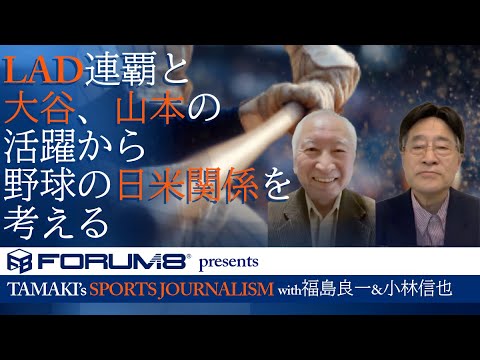
【W32E1】Thinking about JPN-US relations through the LAD Guests: Yoshikazu Fukushima, Nobuya Kobayashi
[Music] Good evening, everyone. It’s time for Forum 8 Presents Taki’s Sports Journalism . I’m sports writer Kosa, your host. This channel is a program that delivers sports culture commentary by Masayuki Tamaki, examining the true issues of sports from a different perspective than conventional programs. I’m commentator Masayuki Tamaki. Nice to meet you. Yes, nice to meet you. Yes, nice to meet you. Well, last time, I talked about Japanese professional baseball, Japanese baseball, and made some interesting suggestions and talked about what to do about it. Today, I’m going to talk about the relationship with the Major Leagues over the course of three episodes, and I thought I’d like to continue doing that. Yes. The reason I think that is because I don’t think there’s ever been such an interesting year in the Major Leagues, and I thought that if you’re in the Major Leagues, you absolutely have to listen to what he has to say, so I’ve invited Hajime Fukushima to join us. Mr. Fukushima, nice to meet you. Yes, nice to meet you. And, Makoto Kobayashi, the sports writer who also appeared on the Japanese Professional Baseball program, nice to meet you. Nice to meet you. Anyway, Fukushima-san , has there ever been a World Series as exciting as this year’s? Well, it started in 1903, yes. It’s a World Series that’s been going on for over 100 years, yes. Well, it was a heated battle, one that could be called the best ever . Ah, I see, that’s what I thought. Yes. Oh, a little while ago, that Chicago Cubs, how many years was it? Maybe 100 years? That was 108 years. It was the first time they’d been to the World Series in 108 years . And even though the Americans caused a bit of a fuss, how should I put it? The content of the games was incredible this year, wasn’t it? It was. Yes, well, there were record-breaking players, yes. The official ones, yes. One after another, yes. And it went all the way to Game 7. And at the center of it all, well, the main character, you know, was a Japanese player. In that sense, it was unlike any other in history . Yes. It was a very exciting series. Fukushima-san, was Game 3 the most memorable? Well, it had to be Game 3. The win in the 18th inning. Yes. In the 18th inning, I thought, uh, Yamamoto Yoshi, uh, uh, was going to pitch, and Freeman saw that and hit a home run. The 18th inning was amazing, but Makiri was amazing, too. Yes. And in that game, Shohei Ohtani, batting first, uh. It almost seemed like he reached base in every at-bat. And two of those were from Homare, uh. Two from Lee, uh. Well, it was truly a historic performance. Yes. It feels like he was kind of overshadowed by that old man and Yamamoto, uh. Ohtani was amazing back then, and not just in the World Series, but in the playoffs, too. Yes. That’s right. He pitched and avoided strikeouts. That’s right. He hit three home runs a game against the Brewers, and I’m not sure what to say about that. Yes. It’s miraculously interesting, isn’t it? That’s right. Well, that was the original two-way player, Babe Ruth. Yes, in 1918. He made a name for himself as a two-way player . Yes. Yes. At that time, he won two games as a pitcher, yes. Well, as a batter, Homura didn’t have a single hit. That seems like a good idea. Yes. Well, when you think about it, Shohei Tani’s performance this time was truly a great performance, pitching to Higashida and passing the ball back to Higashida . That’s right. And, well, Ohtani was also selected as the MVP for the entire season. Wow , this fourth MVP is second only to Barry Bones, right? That’s right. Second only. Second only. Well, there are a few people who have won three times, like Jodi Maggio. Still, the number of MVPs in the major leagues is so high . Fukushima, what do you think about this happening? Do you want to predict it? No, no, I never expected it at all. Well, this might be a rude question for you, Fukushima-san, but you were completely blown away when you first saw the Major League Baseball, and since then, you’ve been covering the sport, following it, and writing about it ever since you were young . What’s it like when something like this happens? I don’t mean that you imagined it or anything like that . Did it ever cross your mind that Japan-US relations would develop into this kind of relationship? No, not at all. Yes. Anyway, over 50 years ago , yes. When I first started watching Major League Baseball, yes. Well, the difference in ability between Japan and America was a matter of luck . Yes. At the time of the Japan-US Rookie Baseball Tournament, only one team from the Major League came to Japan . Yes. Against the Major League teams, who were just sightseeing , yes. Japanese teams were no match for them . Yes. That was true even for the Giants during their time in the V. That’s right. Yes. Well, you know, when the Major Leaguers came to Japan, you know, the schedule said Japan Tour, and yes. Well, it seems like it started out as just a group of players who came for sightseeing . What do you think about that? And, from next year onwards, more and more players will want to go to the Mejia again, and I’ve heard people say that from now on, Japanese players will be coming into contact with Japan as well. It ‘s true that this year the Dodgers won back-to-back World Series titles for the first time in the 21st century, with the Mejia. Shohei Ohtani was the regular season MVP. And Shohei Tani was the playoff MVP . And Yoshinobu Yamamoto was the MVP for the Badgley Series . So, all Japanese players have monopolized the MVP awards. Ah, that’s true. Well, in that sense, the Dodgers’ second consecutive championship this year wouldn’t have been possible without the presence of Japanese players . Yes. Yes. So, going forward , Major League teams will need the power of Japanese players even more to customize their teams. So, I think we’ll see an increase in the trend of Japanese players wanting to go to the majors . I see. But I have one question for you, Fukushima-san: Are you happy about this situation? To be honest, I have mixed feelings. Oh , I see. Yeah, well, when I first started to like Major League Baseball 50 years ago, I had this image of the majors being so strong, yes. Japan couldn’t compete with them. Yes. I admired their strength. Ah, I see. Yes. Yeah. So, you’re saying that the majors don’t seem so strong anymore? I see. So, as someone who’s been watching for a long time, I have mixed feelings about that. Yeah. I see. The first time I saw a major league game in person, I was standing on the field at Yankee Stadium , and I saw Les Jackson right in front of me. I was so overwhelmed by Les Jackson’s batting that I remember thinking, “There’s no batter in Japan who can bat like that .” I remember coming home thinking that. That must have been in the late 1970s. That’s about it. It wasn’t heaven. It was the playoffs, though. In that sense, I was just as surprised as Fukushima-san that he would make it to the majors with the Athletics. Yes. In that sense, how can I put it? Can I say that they’ve gotten closer? Japanese baseball has completely done that. The gap in ability has narrowed . Well, in a way, Japan is doing a good job, yes. Anyway, I really never expected that Shohei Ohtani, the best player in the baseball market, would come from Japan. I see. So, I asked Fukushima about this year’s Major League Baseball, and Kobayashi-san, are you happy? How are you? Oh, no, not happy at all, I guess I’m just looking at reality in amazement. I see. When you look at reality in amazement, that’s true. There are times when you can’t help but be amazed. Listening to you two talk, I felt a lot of things, but I think people who have been having this conversation for about 50 years now , and one more thing, as Fukushima said, I don’t think Shohei Ohtani’s two-way play will last that long, or rather, I think it would be better if it didn’t last that long, so I felt like this fall was one of the peaks of Shohei Ohtani’s two-way play. Yeah. Yeah, I guess so. Yeah. But, Ohtani was, how should I put it? a pitcher, and he was coming off rehabilitation this season, so next year he’ll be more professional. I’ve heard that kind of opinion, too. What do you think , Kobayashi? It’s hard to say anything about that opinion. Yeah. Well, there’s always the possibility of another injury, so yes. Yeah. And, well, I want him to stop pitching. It’s not that he’s bad at pitching, but I want him to focus on batting. And I’d like to see him play in the field, too. I see. Yes. Yeah. Yeah, well, I think there are a lot of fans who feel the same way. And then, well, maybe not as much as it is in a sense, but I think it’s possible that fans who really enjoy things like Ohtani’s fielding might discover a new Ohtani. I see. That’s right. That’s right. This year, thanks to his return to his dual-wielding style, his number of stolen bases has decreased , and last year, when he was a pitcher , he threw over 50 balls and hit 50 home runs, which is something you don’t see anymore . Yes. I still want to see Kokoro’s, that whatever-sweeper slider, what do you think about what Fukushima-san and Kobayashi-san just said? Yes, I certainly agree. I totally agree. Yes, but I think Ohtani’s heart is that he wants to accomplish things that no one else can , and he has a strong desire to keep going . Yes. And, deep down, he’s already won the MVP four times, so I think he’s hoping to win the season award this time . I see. But when Fuku-Schaefer puts it that way, I can’t help but think that it’s an exaggeration, and I can’t say it anymore, but the way the base is rising, you know? Yeah. Well, in terms of skill, it’s just unthinkable, isn’t it? But what do you think? Don’t you think that compared to the exciting Major League Baseball, isn’t Japanese baseball a little less harmful? What about Fukushima-san? Well, that’s certainly true. Even when you look at the reports, well, on TV and stuff like that, yeah. That sport really starts with Saturday Ja-Ja. Ohtani Shohei. That’s what this year has been like. Today. The news about Japanese professional baseball is really like Saturday Ja-Ja, and it’s really hidden by the furniture. It was the same with the Japan Series standings. It’s so true, it’s like I don’t even know if I’m playing . Yeah. Last time, when we spoke at length about Japanese professional baseball, we ended up talking about what to do about it, but do you think so, Fukushima-san? Yeah. That’s right. That said, the numbers related to Japanese professional baseball are also, uh, on the rise. No, it’s increasing. You could almost say that every game is sold out, and the crowds are reaching their limit. Yes. And, as I said earlier, the strength of Japanese baseball is steadily improving . Yes. So, in that sense, I think it’s a very attractive baseball club. Yes. But it’s not getting much attention, like it’s not being made much of in the media. Yes. I guess that’s what America does so well in Major League Baseball. Well, I guess it’s market expansion. Ah, expanding the market. Yes. Not just in the US anymore. All over North America. And, they’re making efforts to spread baseball all over the world, to expand the popularity of Major League Baseball. That’s right. Yes. They’ve been doing that for a long time. For example, the Doors built a baseball stadium in China. Oh, that ‘s right. That’s right. There were things like that. Yes. That was in the ’80s. It was the ’80s, wasn’t it? During the Mari era, yes. They built a baseball stadium in Tianjin, China. Yes, up until then. Well, to go even further, it was really around 1917. Yes. Yes. Major League Baseball was broadcasting all over the world. Ah. Yes, yes, yes, yes. And then they came to Japan in 1931. And, well, even in the 21st century, they’ve been holding opening games in more and more countries outside of America. Yes. First it was in Australia. Yes. Yes. Later it was Korea, Japan, etc. Yes. I see. So that’s one strategy that’s paying off. Yes. Well, it all started with pitcher Nomo’s success in 1995. And, well, the first opening game was held in Japan in 2000. So, over the last 25 years, it’s really expanded immensely, especially in order to spread it even more. I see. What do you think, Kobayashi? What did you think of Fukushima’s explanation? The significance of the major leagues holding opening games and games all over the world… Yeah. I think there’s one more thing we don’t quite understand. So, for example, what’s the significance of holding it in London? Will merchandise sell in London? Or will satellite broadcasting increase viewership? Or will more people play baseball in London? Or is it enough to increase the number of viewers? What was the strategy behind that? Well, Kobayashi-san, if you stop at expanding the market, it’s just about making money. What do you think, Fukushima-san? What’s the major leagues’ thinking on that? Well, especially in Europe, I think it’s about increasing the popularity of baseball. So, what will improve as a result of that popularity? Well, anyway, the big sellers right now are the UK, right? And, well, France will probably hold a major league game soon, but I think that’s going to increase the popularity of baseball in that area . Well, the Mirko style of baseball is to get people interested in baseball. That will result in as many players as possible wanting to play baseball, which will in turn lead to teams and leagues and a higher level, and eventually, we’ll want to produce many major leaguers from those European countries . I see. If that happens, if a European major league is born, then yes , the popularity of those countries will increase. And interest in Major League Baseball will also increase. I see. Yes. Nowadays, it seems that the attitude towards baseball has changed quite a bit in places like the Netherlands and Italy, and in Italy, especially, there are Italian-Americans like Jodi Maggio. I’m sure Vera was one of them, too, and there were a lot of players there, so they’re keeping that in mind and spreading the word . Well, especially in Europe, baseball’s popularity is on the rise in Italy and the Netherlands. That’s right. That’s right. And, well, parallel to that, there’s also the WBC. Oh, what about that? For example, next year it’s being sold to Netflix and stuff, so in Japan, how should I put it, it’s a little removed from everyday viewing, but does that mean it’s still going to grow as a strategy? Well, next year marks the 20th anniversary of the WBC, so yes. Well, especially in the case of the WBC, 20 countries from around the world are participating . After all, in Europe and other countries where baseball is still popular, yes. It’s a really important tournament that can be relied upon to boost baseball’s popularity. You just said 202 countries. Of course, it’s 20 countries. Yes. Well, compared to soccer, it’s only 10% of what we’re making a fuss about, so that’s what it comes down to. That’s right. Well, it’s no comparison to the FIFA World Cup, but , well, it will take many years, a long time, but it started with the desire to make it as close as possible to a tournament like the FIFA World Cup in the future , right? I see. Kobayashi-san, what do you think? What is the strategy of the major leagues? Well, in the end, it’s all about concentrating on America, right? Well, you know, every country can have a league, but the structure where the American major league is at the top isn’t going to change at all, and in that sense, even if you’re an American sports person, American football is popular in Korea, but, well, it’s still the NFL. Is that the mindset in America? Yeah. That’s right. Yeah, well, in the case of soccer, the tradition of being born in England and having players from all over the world come to England to play soccer was born, and then the continent, centered around France, created FIFA, which competed with England and spread all over the world. More than 20 years ago, I wrote an article from the perspective of soccer , saying that we needed to create a global baseball organization to replace the American major leagues. But Fukushima-san, I think that was just a pipe dream. What do you think? That’s certainly true. And in the case of Major League Baseball, yes. It’s the pinnacle of baseball in the world. Well, it’s not just the skill, but the climate and the organizational strength are overwhelming. Yes. For example, was it last year, the revenue of the entire Major League was , um, 1.89 trillion yen? Ah. Yes. And this year, I think it’s on track to reach around 2 trillion yen . Yes. It’s really, really, compared to Japan’s prime ministers, it’s completely incomparable . It’s just that big. That’s right. Yes. Anyway, in the case of the major leagues, there’s no foreign player quota at all . Yes. Yes. They just keep recruiting talented players from all over the world. That raises the level, and they think that will increase their popularity around the world. Well, I do n’t think this structure will change much. I see. So there’s Major League Baseball, and then there’s the NFL for American football, and then there’s the NBA for basketball, and then there’s the NHL for ice hockey . I guess the American-centered culture here, or should I say, that doesn’t spread globally like it does in soccer. [Music] I see. Yes. Mr. Kobayashi, yes. Is it a shame? How should I put it? Yes. Like Mr. Fukushima said, I did a little research and found that there are 165 foreign players on this year’s opening roster . Ah, that’s apparently 27.8% of the total . Yes. So, more than a quarter of the players are foreign. I see. And, well, if you look at the minor leagues, yes. It’s really almost 50% , almost half, made up of foreign players. Ah, I see. Yes. Well, those big hitters are players from Central and Southern Europe. Yes. Yes. So, as Mr. Ki mentioned earlier, there are several countries within the continent of Europe, and each country has its own soccer league, but America, well, North America, there’s Canada, yes . I guess you could say America is number one. I don’t know if it’s because of the geographical environment that there are no rival leagues for basketball, American football, or baseball yet , yes. But I guess that’s why American football and baseball don’t have the same international reach as soccer. What do you think? Fukushima-san. Yes. Is it fair to say that baseball, especially Major League Baseball, has no international reach? Or, as you said earlier, if you include the minor leagues, about half of the players are foreign, so would it be better to say that it has international reach? Which is it? Well, the majority of those foreign players are from Central and South American countries, as I mentioned earlier , so if you think about it, it’s really North and South America , and if you leave that aside, it’s mostly Asian countries like Japan, Korea, and Taiwan . But it’s still nothing compared to soccer. I see. And that’s why Major League Baseball is trying to raise awareness of baseball worldwide . Well, they’re making efforts, but even if baseball becomes more popular in European countries in the future, I don’t think it will change the movement centered around the American Major League. I see. What Fukushima-san said earlier is still in the back of my mind, and what he said about the match being played in France soon is still stuck in my head. Is that really true? Will it be played in France? Yes. Actually, I don’t remember when it was, but it was really planned to be played. Yes. Yes, but, well, it got postponed due to some initial reasons. That said, it should be held sometime soon. I see. Yes. Well, they’ve played it two or three times in London. Yeah. That’s right. So they postponed the next one. Yes. Yeah. In London, they have a cricket tradition, so I think the spectators enjoy watching it, but in France, I saw Yoshio Yoshida of the Hanshin Tigers coaching , and he was saying “yes, yes, come on, yes, come on,” and it didn’t sound like Japanese , so I thought it was strange to play in English in France. And then there was the Montreal Expos. It was French at the time, completely. So, I still have that baton fret, and they explain baseball in French. Yes. I still don’t get it, as expected. [Music] Ah, that’s true. And then I saw a baseball game in Montreal. I saw X, and they were calling it Pokomepa or something. They were talking about the pitcher, Pomibase, that Class 1. Yeah. Ah, yes, yes. And it’s Basesco Fuji. So when I heard Tsuneuchi announce it, it felt kind of weird. I wonder what the French think of this ball. The French person sitting next to me is completely useless. Yeah. Oh. Yeah. That’s right. That’s true. Um, at Mont-Royce, um, um, it’s French first, then English. That’s right. Yes, that’s right, that’s right. But when I watched the baseball game at Mont-Royce, the only thing I thought was nice was the Canadian national anthem. Canada’s national anthem was beautiful. It was really, in French, um, but it really felt that way, Mr. Kobayashi . Do you think baseball will spread to the world? Aside from English. Well, you know, this is something that’s often said in Japanese PE classes, um, there are several types of sports, like baseball-type, goal-type, and competitive types. And in a 100m race, the outcome is easy to understand for anyone who watches. I think so. Yes. So in soccer, well, like basketball, it’s easy to understand that the ball will get into the goal. Ah, I see. But what’s so interesting about baseball-type sports? Usually, you score when the ball goes into the goal, but in baseball, you score while the ball is still on the other side , so it’s hard to get into unless you’ve been familiar with it since childhood. I see, that’s definitely a difficult part. This is getting really interesting, so I’ll wrap up the first episode here and continue in the second episode. Since Kobayashi just mentioned it, I’ll jump right in. Actually, I’ve heard the same thing said before, but it was the film director Ichikawa Kon. Oh, Ichikawa Kon made a film about the Tokyo Olympics, right? Yes. After that, he thought sports films would be interesting, so he made “Seishun.” I think it was around the time that Niura, the high school baseball player , was in the finals. Ah, Shizuoka Commercial High School. That’s right. That’s right. So, I made this film called “Seishun,” and when I asked him what he thought of it, he said it was no good at all. Is that right? If you ask me what’s wrong, it’s because when they score and celebrate, the ball is on the other side and the player is on this side, so I have no idea how to capture it on camera . So, you said you were stuck on that. Now, I’d like to start talking about whether baseball will spread around the world from the next episode, so Fukushima-san, please look forward to the next episode. Thank you very much. Thank you very much, Kobayashi-san. Let’s wrap this up for the first episode. Yes. Thank you everyone for watching. The next episode of Forum 8 Presents Taki’s Sports Journalism will be this week’s theme: Thinking about Japan-US baseball relations from the success of the Japan League and Otani Yamamoto, Episode 2: Why has the MLB ball become so interesting? We’ll continue with Fukushima-san and Kobayashi-san. See you all in the next episode . Bye. [Music] [Music]
Guest: Major League Baseball commentator, Yoshikazu Fukushima
Author and sports writer, Nobuya Kobayashi
Commentator: Masayuki Tamaki
[WEEK 32] Considering Japan-US baseball relations through the Dodgers’ consecutive championships and the success of Ohtani and Yamamoto
[EPISODE 1] Looking back on the past year in MLB from an exciting postseason
Fukushima Ryoichi
X: https://twitter.com/yoshfukushima
Instagram: https://www.instagram.com/yoshfukushima/
Kobayashi Shinya
Website: http://www.nobuya.jp
X: https://twitter.com/nobuya_k
Instagram: https://www.instagram.com/nobuya2020/
Facebook: https://www.facebook.com/nobuya.kobayashi.399
note: https://note.com/nobuya_saikou
Youtube: https://www.youtube.com/@kobayashi Shinya-m8u
[Channel Partner] FORUM8
Official Website: https://www.forum8.co.jp
X: https://twitter.com/FORUM8JP
Facebook: https://www.facebook.com/forum8JP
Instagram: https://www.instagram.com/forum8jp/
YouTube: http s://www.youtube.com/c/FORUM8Japan
Channel guidelines: https://www.youtube.com/watch?v=pQSR_zmdhE8&t=44s
*Scheduled to be streamed twice a week, Monday and Thursday, from 6:30 PM
Masayuki Tamaki Official Website: http://www.tamakimasayuki.com
Channel Official X: https://twitter.com/TAMAKIS_SJ
#MajorLeague
#MLB
#Dodgers
#YoshikazuFukushima
#NobuyaKobayashi
#LAD
#WorldSeries
#ShoheiOhtani
#YoshinobuYamamoto
#RokiSasaki
#MasayukiTamaki
#FORUM8
NPBHUB.COM | The Fanbase of Nippon Baseball & Nippon Professional Baseball