
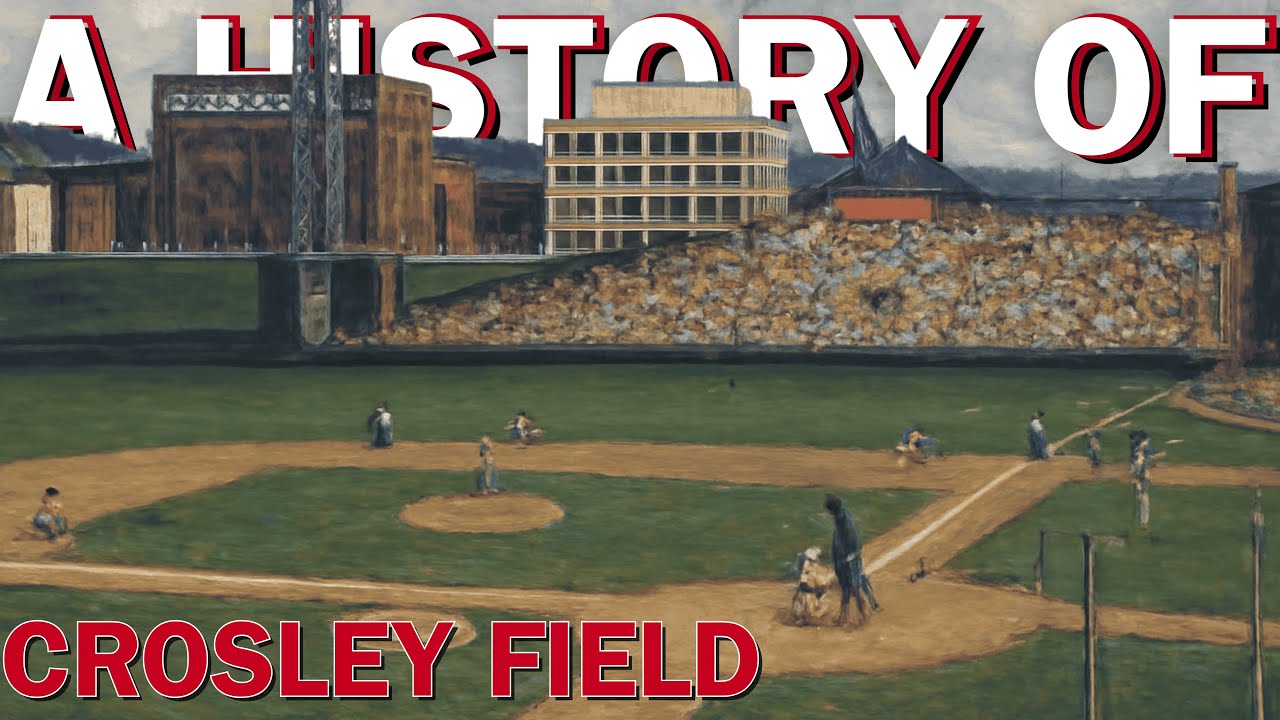
A History of CROSLEY FIELD | Part 1
As time goes on, baseball stadiums
become holy grounds. A place where friendship and family reinforce their bonds
through a mutual love of a simple ballgame, and the inherent pleasure of being
together. These monumental structures, fashioned from concrete and steel, serve a purpose
far beyond baseball itself. A sacred ground where people shed their monotheism and pray to the
baseball gods to favor their team. Every diamond, from Little League to the Big Leagues serve as
a temple to the game, each with their own story. Today we will be talking about one of the most
iconic jewel-box ballparks ever constructed. One of the first concrete-and-steel behemoths
erected to host the beautiful game of baseball. Located in the Queensgate neighborhood in the city
that birthed Major League Baseball, Cincinnati. For 58 and a half seasons, this ballpark stood at
the corner of Findlay and Western, hosting some of the greatest players and moments the game has ever
seen. From the most prolific groundskeeper of all time to Major League Baseball’s first night
game, welcome back to The Bad Baseball Fan, let’s explore the history of Crosley Field.
Before we jump in, I just want to thank you for being here, and remind you to
like, subscribe, and comment. You’re engagement and support make these historical
explorations possible! Alright, let’s begin! “Crosley Field was an oasis in the middle of a
brick and smokestack-filled desert.” – Ron Smith, A Journey Through the Fields of Baseball Magic
Many baseball fans are aware that the first openly professional baseball team came out of Cincinnati,
Ohio in 1869. That original iteration of the Cincinnati Red Stockings disbanded following
the 1870 season, and it would be more than a decade before another team established themselves
in the city. A charter member of the American Association, the Cincinnati Reds were established
ahead of the 1881 season. This Cincinnati baseball team spent its first three years at a field known
as the Bank Street Grounds, located roughly where Bank Street meets Western Avenue and Mclean Avenue
today. Following the 1883 season, they were forced to vacate the facility because their lease had
been sneakily sold behind their backs to a new Union Association ball club. So, ahead of the 1884
season, they moved a few blocks south to an old, abandoned brick yard, and built a new ballpark
at the corner of Findlay and Western to be known as League Park. The Cincinnati Reds would
call this lot home for the next 87 seasons. During their time at League Park, the grounds were
tended to by one John Schwab, who, in 1893, took his son Matty under his wing as an apprentice. Put
a pin in that for now, and remember Matty Schwab’s name. He may just be an apprentice groundskeeper
at this point, but we’ll circle back to him. Cincinnati’s League Park had a limited capacity
of only 3,000 during its first decade of use, seeing its Reds leave the American Association,
and join the National League during that time. It was given a facelift in 1894 to raise the seating
to 7,000 and had to be partially rebuilt following a fire in 1901, giving it a final seating count of
9,000. Desiring a more modern baseball facility, team owner John Brush had a new grandstand built
for the ballclub, to be known to the world as the “Palace of the Fans”. Construction lasted
through 1901, and she was ready for use for the 1902 season, and when all was said and done, the
new grounds had an increased capacity of 12,000 seats. This new, wooden “Palace of the Fans”
was not built to last though, only lasting ten seasons before Reds president Garry Herrmann
made the decision to modernize once again. Having witnessed the construction of new
concrete-and-steel ballparks in Philadelphia and Pittsburgh, Herrmann realized the opportunities
the new “fireproof” ballparks could provide, and sometime in 1911 he hired local architect Harry
Hake Sr. to design his new palace. Plans were drawn up, the Palace of the Fans and any remaining
grandstands from League Park were demolished, and construction quickly began upon the conclusion
of the 1911 season. The project was completed at a cost of $250,000, and was completely finished in
time for the 1912 baseball season. In five months, the new concrete-and-steel ballpark was erected;
featuring double-decked grandstands that wrapped around home and extended to the end of the
diamond. Beyond the double-decked grandstands were single-decked covered pavilions that extended
to the foul poles, with the only outfield seating being a 4,500 seat section in right field
that would come to be known as the “Sun Deck”. Capacity at this new stadium was initially
20,696, and featured a large outfield with 352 feet down the leftfield foul line, 400 down
the rightfield line and 420 feet to dead center. The two grandstands met behind Homeplate at a
hard angle, giving it a distinctive “V” shape at the backstop, and the outfield featured
a raised terrace as you approached the wall. When I first saw that I though, neat, a primitive
warning track, but no, that wasn’t the intended purpose at all. The raised earth, along with some
areas in foul territory, actually functioned as overflow seating when needed. Speaking of the
earth, from my understanding, groundskeeper Matty Schwab designed a first-of-its kind
underground irrigation system for the ballpark, making the playing surface one of the premier
places to play baseball. With all its quirks and character, the Cincinnati Reds had a shining
new ballpark going into their 1912 campaign. “A bright green carpet covering a
small piece of Cincinnati’s drab, deteriorating West End.” – Ron Smith, A
Journey Through the Fields of Baseball Magic When the ballpark opened its gates on April
11, 1912, the Titanic was still on her lone voyage. Opening nine days prior to Navin
Field in Detroit and Fenway Park in Boston, Cincinnati’s new ballpark was the third-ever
concrete-and-steel ballpark. An over capacity crowd of 26,336 fans showed up to the still
unnamed stadium to watch their Reds host the visiting Chicago Cubs. Down 5-1 going into the
bottom of the fourth inning, the Reds put up a six spot to take a 7-5 lead. They never looked back,
closing the game out for a 10-6 win, celebrating their new ballpark in style. A day later, Garry
Herrmann decided to name the park Redland Field in honor of the ballclub. The Reds would go
on to finish just under .500 and in 4th place in the National League. A rather unremarkable
first season in a remarkable ballpark. Redland Field hosted 344,000 fans in its season, and
just like the team, finished in fourth place. The Reds performance was consistently mediocre
throughout the 1910s, as was attendance at their new ballpark. Through the 1918 campaign, the
Reds finished as low as last in the NL, and as high as 3rd. Redland Field, in spite of being a
state of the art facility, struggled to bring in competitive attendance numbers, as high as fourth
place, but as low as last. As a matter of fact, 1914 saw Redland Field host an abysmal 100,791
fans across the season, even less than they would host during the war-ravaged 1918 campaign,
when they saw 163,009 people enter the gates. Everything took a turn for the positive in 1919.
Led by manager Pat Moran, the Reds finished the season with a 96-44 record and in first place,
earning their first ever National League pennant. Attendance numbers took a huge jump, as for
the first time since its inaugural season, Redland Field surpassed 300,000 fans
for the year. Not only was that their first time hitting that mark in 6 years, but
they also managed to pass the 400,000 mark, and then the half a million mark, for the first
time-hosting 532,501 fans across the year. Led at the plate by Edd Roush who batted
.321, and on the mound by Dutch Ruether who posted a 19-6 record with a 1.82 ERA, they
cruised to their first pennant, claiming it by 9 games over the New York Giants, and earning
themselves a spot in their first World Series. The 1919 Fall Classic was one of the rare World
Series to be formatted in a best-of-nine style, with Redland Field hosting games one, two, six,
and seven. Cincinnati took 4 of the first 5 games, including their two at Redland Field, putting
the Sox backs up against the wall. Chicago clawed back into the series, taking games six
and seven in Cincinnati, before returning to Chicago for what would end up being the series
ending game. Hod Eller took the mound for the Reds and Lefty Williams for the Sox, with Eller
getting the best of Williams, who was shelled in the first inning. Jumping out to a five run lead
after 2 innings of work, Cincy sealed the deal, and took the game 10-5. The Cincinnati Reds were
champions of the world for the first time ever. “It was a colorful Mecca in a
sometimes-gray world, a place of renewal and rejuvenation.” – Ron Smith, A
Journey Through the Fields of Baseball Magic Less than a year after winning the World Series,
their championship had its validity challenged when it was uncovered that eight of the White
Sox had conspired with gamblers to throw the 1919 World Series. Even with the power of hindsight,
there have been plenty of baseball historians who believe the White Sox would have likely won
the series had they been on the up and up, but I don’t necessarily subscribe to this line
of thinking. The White Sox were heavy favorites to win the series, but that does not mean they
were guaranteed to. We know now that the Black Sox themselves went back and forth on the
issue throughout the series, meaning they threw some games, and played hard in others; so
I believe its virtually impossible to actually analyze the validity of the Reds championship.
Unfortunately for Cincinnati, this scandal burned a lasting mark into their first championship.
The Reds would fail to capture another pennant throughout the next decade, though it should be
noted that the Cincinnati Reds finished every year of the decade, excluding 1929, with a winning
record. Attendance at Redland Field often mirrored that of their teams play on the field, good, but
not incredible. Most seasons through the 1920s saw attendance fall somewhere between 300,000 and
600,000, though they did eclipse the 600,000 mark for the first time in 1926, when the 87-67-3,
2nd place Reds drew 672,987 to their games. The lack of championships didn’t mean the decade
was stale though. June 2, 1921 saw the first ever over-the-fence homerun at Redland Field, as
outfielder Pat Duncan smashed a ball over the left-center wall. It took more than nine
full seasons before the feat was accomplished, and a patrolling police officer on York
Street was struck with the homerun ball. Redland Field also got its first
makeover during the decade, when in 1927, Homeplate was moved up roughly 20 feet, and
the lower grandstand was extended towards home, cutting the outfield distances down to a much more
hitter-friendly 339 feet down the left field line, 377 down the right field line, and 400 feet to
dead center. The franchise also added a brand new scoreboard in left-center, that was designed
by none other than groundskeeper Matty Schwab. The system of displaying the lineups, created by
Schwab, is still used today by most ballclubs. Just like that, Redland Field was modernized and
featured an expanded capacity of 26.060. The same year, team president Garry Herrmann retired,
and he was succeeded by one C.J. McDiarmid, who held that post for 2 years before he
was undercut and forced out of his job. In September of 1929, a local Ford dealer and
Reds fan by the name of Sidney Weil wanted to purchase the ballclub. He approached McDiarmid
with an offer to buy his share of the team, but was rejected. Determined to reach his
goal, he went behind McDiarmid’s back to other minority shareholders, offering up to 4x
the value for their shares. They caved and sold, and Weil quickly became the majority owner, and
his first move in the role was to fire McDiarmid. The ends ended up not justifying the means though,
as in order to complete his inflated purchases, he had to borrow significant capital from the
Central Trust Company. If you’re a student of history, you may have already connected the dots
here, but quite plainly, Sidney Weil took out large loans about a month before the stock
market collapsed and the country fell into the Great Depression. Weil was the team owner
until 1933, spending his entire time with the team struggling to keep the ballclub afloat.
Despite his relentless efforts, the quality of play on the field and the attendance numbers
were consistently bad while he was at the helm. By 1933, the Central Trust Company was forced to
act, and seized all of Sydney Weil’s assets. Not just the team and stadium, but his car and
home too; leaving him with just the clothes on his back. Now in control of a Major League
Baseball franchise, the CTC had to act quickly to stabilize the Cincinnati Reds as a business,
and they quickly installed Larry MacPhail as team president to handle the job. MacPhail was
tasked with finding a permanent team owner, and with devising ways to draw greater attendance
to the ballpark. By 1934, MacPhail had found his man in local car manufacturer Powel
Crosley of Crosley Motors Incorporated. Crosley balked at the idea of buying the team,
fearful that it would turn into a bottomless money hole, but MacPhail made the matter one of
civic duty, implying heavily to Crosley that if he did not buy the Reds, they would be forced
to leave Cincinnati for another city. Crosley, a lifelong Reds fan, bought the team begrudgingly,
not wanting to see his Reds go anywhere else. MacPhail did have a solution to help
offset some of the costs though, when he suggested that Powel Crosley rename
Redland Field in both his and his companies honor. Starting in 1934, Redland Field
would forever be known as Crosley Field. Thank you for joining me for
part one of our exploration of Crosley Field. If you enjoyed this
video, make sure you like, comment, and subscribe to the channel! If you’re looking
for more ways to support the Bad Baseball Fan, consider becoming a member of the channel, or
browse through our merch linked below! Anyways, I’ll see you next time, and remember, if you like
baseball, like this video and subscribe for more!
Store: https://thebadbaseballfan-shop.fourthwall.com
Socials: TikTok – https://www.tiktok.com/@thebadbaseballfan Instagram – https://www.instagram.com/thebadbaseballfan/ Threads – https://www.threads.net/@thebadbaseballfan?xmt=AQGzDw82lh7BdWWMPsx6SI9KwBLhWy69i2S7QPaAZH2qH6g X – https://x.com/BadBaseballFan
Further Reading:
Bandbox Ballparks:
YouTube: https://www.youtube.com/@bandboxballparks7081
Website: https://bandboxballparks.com/
Sources:
“Crosley Field (Cincinnati)”, Lon Garber, SABR:
“Crosley Field, Cincinnati, Home of the Reds (NL), (1912-1970)”, National Ballpark Museum:
“Crosley Field Historical Analysis”, Baseball Almanac:
https://www.baseball-almanac.com/stadium/st_crosl.shtml
“Crosley Field”, Wikipedia:
https://en.wikipedia.org/wiki/Crosley_Field
“May 24, 1935: Reds fans see the lights in first night game in MLB history”, Norm King, SABR:
May 24, 1935: Reds fans see the lights in first night game in MLB history
Logos provided by SportsLogos.net
NPBHUB.COM | The Fanbase of Nippon Baseball & Nippon Professional Baseball