
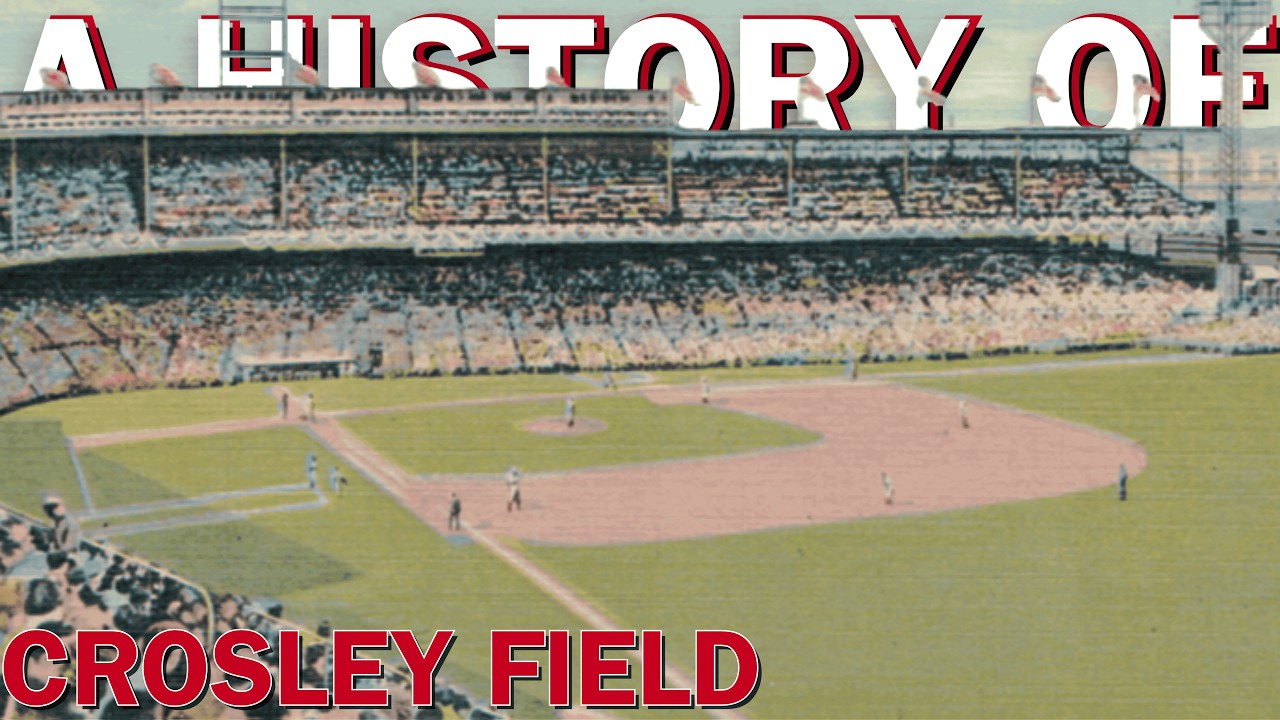
クロスリー・フィールドの歴史 | パート2
Welcome back to A History of Crosley Field.
This is part two of a three part series, so if you haven’t seen part 1 yet, click
this card in the corner to get started. Other than that, like, comment, and
subscribe, and let’s get into it. With the Cincinnati Reds getting a new owner, and
their ballpark being christened with a new name, drawing greater attendance became the primary
focus of the front office. Larry MacPhail, charged with alleviating this issue, realized
that offering night games to his fans could be an excellent way to draw attendance, given
working hours lasted through the day. Following the 1934 season, he managed to convince Crosley
to spend $50,000 to install permanent lights at his ballpark. 632, 1-500 watt bulbs were installed
atop eight separate light towers positioned around the stadium, making Crosley Field the first
stadium in Major League History to feature permanent lights. It should be noted that night
games had been experimented with before in both the Negro Leagues and in the Minor Leagues, but
at that point in time, it hadn’t been tried in the Majors. The lights were installed, and
the first night game was set for May 24, 1935, against the Philadelphia Phillies.
According to Norm King in his fantastic article about the game for the Society for American
Baseball Research, the day was one of celebration, with pregame festivities including fireworks and
music. The festivities lasted until sundown, when President Franklin D. Roosevelt, from the White
House in Washington D.C., pressed a telegraph button that illuminated Crosley Field with over a
million watts of light. National League president Ford Frick threw out the first pitch, and in front
of a crowd of 20,442, the first night game in Major League history was off to the races. Paul
Derringer took the mound for the hometown Reds, facing off against the Phillies’ Jim Bowman.
Derringer went the distance, only allowing a run in the 5th, while his team scored a run in the
1st and 4th innings. The score would hold at 2-1, and the Cincinnati Reds would claim victory in
that historic night game. The new late night time slot did wonders for attendance at Crosley Field.
In 1934, the Reds drew a measly 206,773 fans, but in just seven night games alone in
1935, they drew 130,337. At the end of 1935, total attendance at Crosley Field had more than
doubled from the year prior, landing at 448,247. I also would like to note that the “Sun Deck”
was rebranded as the “Moon Deck” for night games, a fun little bit of stadium lore.
The rest of the 1930s ended up being quite eventful for out little old ballpark. A
little more than a year and a half after the first night game, Crosley Field was struck
with catastrophe. On January 24, 1937, the nearby Mill Creek overflowed, flooding the local
area. Matty Schwab’s revolutionary underground irrigation system backfired, flooding the field in
over 20 feet of water. An absolute disaster, but a task not too tall for Mr. Schwab, who had the
field drained and ready for play by opening day. The following season, Crosley Field played host
to the first leg of one of the greatest pitching achievements in baseball history, when Johnny
VanderMeer through back-to-back no-hitters. The first game of this incredible feat took place on
June 11 at Crosley Field against the Boston Bees, then, just four days later, during Ebbets Field’s
first night game, he did it again. Less than a month after VanderMeer’s no-hitters, Crosley Field
had the honor of hosting MLB’s 6th ever All-Star Game. In front of a crowd of 27.067, the National
League dominated that game, nearly shutting out their American League opponents, but relenting one
run in the ninth, to win the game 4-1. Following the All-Star game, the Reds wrapped up the
season with a winning record for the first time in a decade, as a record 706,756 fans attended
Crosley Field to cheer on their baseball team Then, following that 1938 season,
Crosley Field was given another makeover. The single-decked pavilions that extended
down the foul lines had an upper deck added, and pavilion seating was extended further into
foul territory. Home plate was once again moved forward by roughly 20 feet, and going into
1938, the ballpark featured dimensions of 328 feet down the left field line, 366 feet down
the right field line, and 387 to dead center. When they opened up the 1939 season, Crosley
Field featured an updated capacity of 29.401. “To the Queen of the West, in her
garlands dressed, on the banks of the Beautiful River.” -Henry Wadsworth Longfellow
Following the new renovation at Crosley Field, Mill Creek flooded again, submerging the
stadium in water once more. Unfortunately for Matty Schwab, this time was too close to
opening day, and the first two games of the year in Cincinnati had to be postponed. Despite
a literally disastrous start to the 1939 season, the Reds cruised all year long. A record smashing
981,443 fans entered Crosley Field to watch their Reds rip though the National League to the
tune of a 97-57-2 record and their first pennant in 20 years. Edging out the St. Louis
Cardinals by 4.5 games, the Reds met the mighty Yankees in the World Series. Amidst a streak of
three consecutive World Series entering 1939, there was little the Reds could do to slow the
Bronx Bombers down, quickly getting swept in the series. Crosley Field hosted games 3 and 4 of the
series, seeing the Reds fall 7-3 in game three, then lose a heartbreaker in extras in game
4, to the tune of a 7-4 final in 10 innings. Despite the great season, the Reds just ran
into a juggernaut, and the Cincinnati faithful had to suffer through watching the mighty
Yankees celebrate on their sacred ground. The Reds didn’t miss a beat in 1940, bouncing back
from their World Series loss to the Yankees to capture their second National League pennant in a
row. Hosting an impressive 850,180 fans throughout 1940, the team managed to improve on their record
from the year prior, by finishing with a 100-53-2 season, and claiming the pennant by a massive 12
games over the Brooklyn Dodgers. Their American League counterpart, for the first time in 5
years, was someone other than the Yankees, this time it was the Detroit Tigers. Crosley
Field was set to host games 1, 2, 6, and 7, and all seven games ended up being necessary.
The first two games, played in Cincinnati, were split with the Tigers taking game 1 and
the Reds taking game two. The series continued the same in Detroit with the teams trading off
wins; Detroit in game 3, Cincinnati in game 4, and Detroit again in game 5. Going back to
Crosley Field for Game 6, the Reds had their backs against the wall, and needing a win to force
a winner-take-all game 7, manager Bill McKechnie turned to right-handed starter Bucky Walters to
keep the team alive. Walters dominated the Tigers, pitching a complete game shutout as his offense
scored four runs against three Detroit pitchers, setting up the decisive game 7 the following day.
On October 8, 1940, 26,854 fans arrived at Crosley Field to hopefully witness their Reds complete
their comeback and win their second ever championship. With the series tied at 3, McKechnie
gave the ball to Paul Derringer, and Detroit’s manager Del Baker placed his team’s hopes on the
right arm of Bobo Newsom. Both hurlers went the distance, with Derringer giving up a single Tiger
run in the 3rd, before his offense rescued him with 2 runs in the seventh. The score held, and
the fans at Crosley Field got to witness in person the celebrating of a Reds world championship.
Unfortunately, this was the last time this would happen while the Reds called Crosley Field home.
Following this second franchise championship, the Reds remained competitive for several years,
but couldn’t manage to get over the hump again. Crosley Field may not have hosted another World
Series during the 1940s, but she did play host to some unique moments and players, as well as being
subject to another expansion of sorts. August 29, 1943 sees the largest ever crowd show up at
Crosley Field as 38,017 fans turned up to watch the Reds beat the Cardinals 4-3. Just a year after
that, the Reds treated their fans to the youngest debut in MLB history when a 15-year old Joe
Nuxhall debuts on the mound for the squad. Called in for a mop up role, in the 9th inning of a
blowout loss at home to the first-place Cardinals, Nuxhall took the ball and toed the rubber for
the first time on June 10, 1944. He managed to force a groundout on his first batter, then all
hell broke lose. Managing only one more out for the appearance, Nuxhall failed to get out of the
inning, allowing 2 base hits, a wild pitch, five walks, and five runs across. He was immediately
sent down to the minors, and didn’t return to Major League Baseball until 1952. Nuxhall would
go on to have a solid MLB career for the Reds, before becoming an iconic broadcaster for the
franchise in his retirement. He was inducted into the Cincinnati Reds Hall of Fame in 1968.
A couple of years following Nuxhall’s debut, a new section of seating was added to the
ballpark, when team president Warren Giles adds roughly 700 seats in front of the “Sun Deck”. The
new section of seating represented an animal pen, and quickly garnered the nickname “Gile’s Chicken
Run” before just being shortened to just the “Goat Run”. The temporary seating lasted until
1950, when Giles had it removed during a 16-game road trip. Though the “Goat Run” had no
verifiable advantage or disadvantage for the Reds, their play arbitrarily improved following
the removal of the section. Oddly enough, in spite of the “Goat Run” making Crosley Field
more hitter-friendly, Reds pitcher Ewell Blackwell nearly matched Johnny VanderMeer’s back-to-back
no-hitter’s during the 1947 season. On June 18, he no-hit the Boston Braves at Crosley Field, and
just four days later he came incredibly close to doing it again. Facing the Brooklyn Dodgers at
Crosley Field, Blackwell got as far as an out into the ninth without giving up a hit, before
the Dodger’s Eddie Stanky smacked a ball up the middle and ruined the night. It should be noted
that the two franchises Ewell pitched against were coincidentally, the same two that Vander Meer
had back-to-back no-hit roughly a decade earlier. “This is the old left-hander, rounding third and
headed for home. Goodnight everyone.” -Joe Nuxhall The Cincinnati Reds entered the 1950s
wallowing in, at best, mediocrity. In 1951, team president Warren Giles leaves his
post to become the President of the National League, and Powel Crosley promotes one Gabe Paul
to team President. Within a year, Paul had decided to reinstall the “Goat Run”. The Reds featured
several power hitting prospects, including a left-handed Ted Klusewski, and Paul believed the
slightly shortened porch in right field could work to the Reds advantage. While its hard to discern
if the “Goat Run provided any real advantage at all, the Reds did objectively hit with more
power throughout the decade, and its quite likely that the “Goat Run” helped contribute to that.
The year after the “Goat Run” was reinstalled, Crosley Field was awarded with the 20th
MLB All-Star game. On July 14, 1953, 30,846 fans packed into the ballpark to witness
the best ballplayers from each league take each other on. Eerily similar to the 1938 midsummer
classic hosted by Crosley, the National League took a shutout into the 9th before giving up a
single run and closing the game out. This time, instead of a 4-1 National League victory,
the margin was instead 5-1. This was the last time that the MLB All-Star game would be
held at Cincinnati’s grand, intimate ballpark. 1956 saw the Cincinnati Reds smash 221
homeruns as a team, establishing a new MLB single-season team record for homeruns. Its
quite possible that the shortened fence in right field contributed to this record, but in spite
of that, just a year after setting that record, Gabe Paul had the Goat Run removed ahead of the
1958 season. Reds fans had widely believed that the “Goat Run” was a net negative for the team,
and following a trade of Ted Klusewski in 1957, it had little further use to the ballclub. It was
quickly removed with little pomp and circumstance. 1956 and 1957 were the only years through
the decade that the Reds finished with a winning record, and the fans repaid them with
attendance. 1956 was an exciting year, as Rookie Frank Robinson won the Reds’ first Rookie of the
Year award, and it was the first time that Crosley Field passed the million mark with 1,125,928 fans
attending games. They then did it again in 1957 with 1,070,850 fans coming to Crosley Field. 1957
also saw the scoreboard replaced with an enormous, 58-foot tall, art-deco style scoreboard that
would become a key feature of the ballpark. As the 1950s drew to a close, there was
little optimism that the Reds would soon play championship level baseball, but in spite
of the, at best, mediocre play on the field, the Reds faithful showed up day in and day out,
establishing a one-of-a-kind baseball culture. Powel Crosley had returned the Cincinnati Reds
to prominence and popularity, but unfortunately, his time was running out, and the early 60s
featured major management changes in Cincinnati. In 1960, he was approached by a group of
investors who were attempting to bring National League baseball back to New York in
the wake of the departures of the Giants and Dodgers. Harkening back to his original reason
for purchasing the team, his civic duty, Crosley refused to sell and allow the team to be moved
from Cincinnati. The lack of stability caused by a potential buyout led Reds President Gabe
Paul to step down, accepting the same position with the new expansion Houston Colt .45s. Crosley
quickly filled that position with decades-long baseball executive Bill DeWitt. DeWitt immediately
began making moves to shore up a roster that only managed 67 wins. After weathering a storm of an
offseason following 1960, things were looking up in Cincinnati. That’s when tragedy struck.
Thank you for joining me for part two of our exploration of Crosley Field. If you enjoyed
this video, make sure you like, comment, and subscribe to the channel! If you’re looking
for more ways to support the Bad Baseball Fan, consider becoming a member of the channel, or
browse through our merch linked below! Anyways, I’ll see you next time, and remember, if you like
baseball, like this video and subscribe for more!
Store: https://thebadbaseballfan-shop.fourthwall.com
Socials: TikTok – https://www.tiktok.com/@thebadbaseballfan Instagram – https://www.instagram.com/thebadbaseballfan/ Threads – https://www.threads.net/@thebadbaseballfan?xmt=AQGzDw82lh7BdWWMPsx6SI9KwBLhWy69i2S7QPaAZH2qH6g X – https://x.com/BadBaseballFan
Further Reading:
Bandbox Ballparks:
YouTube: https://www.youtube.com/@bandboxballparks7081
Website: https://bandboxballparks.com/
Sources:
“Crosley Field (Cincinnati)”, Lon Garber, SABR:
“Crosley Field, Cincinnati, Home of the Reds (NL), (1912-1970)”, National Ballpark Museum:
“Crosley Field Historical Analysis”, Baseball Almanac:
https://www.baseball-almanac.com/stadium/st_crosl.shtml
“Crosley Field”, Wikipedia:
https://en.wikipedia.org/wiki/Crosley_Field
“May 24, 1935: Reds fans see the lights in first night game in MLB history”, Norm King, SABR:
May 24, 1935: Reds fans see the lights in first night game in MLB history
Logos provided by SportsLogos.net
NPBHUB.COM | The Fanbase of Nippon Baseball & Nippon Professional Baseball