
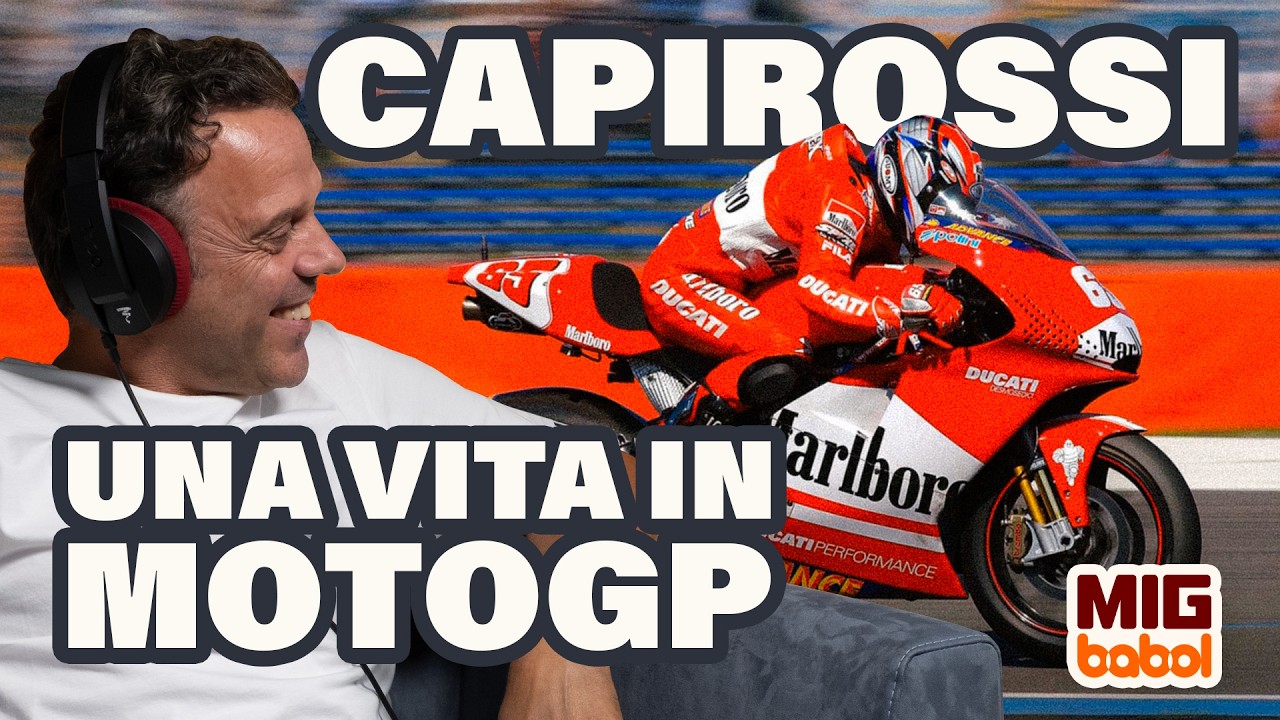
LORIS CAPIROSSI – Una vita in MotoGP – Mig Babol Ep.12 S.2
Big Mig Bubble. Hi everyone, and welcome back to Mig Bubble, the racing podcast that talks about MotoGP and characters from the end of this world. I’m Andrea Minno, and we’re in VRS Studio for another episode. Today, another legendary guest, world champion. We’ll find out how much more he’s up to. On my right, as always—not as always, but the big return of Filippo Carloni Hfisci. Hi Phil, how are you? Hi everyone. Very good. How’s it going? My shoulder is great. Now, yes, now, now. Let’s thank the audience, the applause, and I’d say let’s skip the introductions because, as I said earlier, today we have another key figure, a three-time world champion with the number 65 straight from Castel San Pietro, am I right? Yes, born in Castel San Pietro. From Castel San Pietro, Loris, Capirossi, and Mabubble. Hi guys, hi everyone. So, bye bye bye. Here they are. Hey, hey Oh! Oh, don’t treat me too badly, eh? I ‘m a little scared of these two guys, you know. Anyone who sits on these couches is ultimately a condescending program. Go, go, go. It’s an hour of relaxation. And we always start our episodes with a simple but not trivial question: how are you? How are you? What can you tell us about these days? How are you? How are you? I’m very well, I’m happy, and let’s just say the championship is going pretty well overall. We’re in Misano, so it’s a cool, special event. You know, Romagna is the beating heart of motorcycling. It also seems like the crowds have gotten moving; there seems to be a lot of people on Sunday, and that’s really positive, very positive. Then we’ll see what the track has to offer. The weather looks good, in fact. Yes, yes, except for today. Yes, except for today, when we’re wet, there’s no riding today. Yes, exactly, don’t worry. So I’d like to start right away with this thing, which was a curiosity I had before. How did you experience the EGP at home? How can Misano be right now? Osteria. Very difficult question. Very difficult because in my opinion, if we want to be honest, it was a bit of a mess. Okay. Why? Because there was so much pressure, you know, so much stress. Then the stuff [ __ ] that I like to tell you in a second, without making you waste too much time, people, people think when you’re a MotoGP rider they think you have an envelope, a bag with 250,000 passes inside, so everyone calls you even though you haven’t heard from them, practically for a year, since the year before. Ah, Loris, look, it’s me with two of my friends, his girlfriends, then there’s my uncle, his aunt, 10 passes, 15 passes. That was really something to manage, very difficult. Apart from that, it was still cool. In my opinion, on Fridays when they open, they put the green light, you go onto the track and you’re home, you have a little bit more in your pocket, you feel, you feel better, come on. You feel better. Oh, fans, then on Sundays, both Misano and Mugello. I have to say I’ve always been very attentive. I’d look at the giant screens, I’d look at the crowd, and on the inbound lap with my visor open I’d hear a really cool noise. Yeah, because you can hear the noise from the stands, you can hear it. Well, not in the race, not with the bikes, but when you go into pit lane, you know, you close the throttle before braking, you hear the crowd’s buzz, you see, and it’s beautiful to see, sure, I mean, if you look even while you’re going you can see it, but obviously, look, in the end, not just Italians, but riders in general, live off this too, you know? They give you energy, and doing the Grand Prix in Italy has always been a thrill for me. Then also in Imola, by the way, Correval, so it’s right next to home. By the way, by the way, in Imola, and the last great race was in ’99. I was born in Castel San Pietro, so nearby, then in Imola, and I won that race there, thank goodness, at least the last one we did in Imola I won in 250. Yes, yes. Then a real fight that’s worth it, like it was the Italian championship, but interesting fight, great in those years, then with the 250, Madonna, so much stuff. What little motorbikes, what little motorbikes. Ah, we’ll get there too. But first I’d like to start from the very beginning, from the beginnings, precisely, where you were born, how your passion was born, I read and heard that you are very attached and in any case you have to thank, you have always been very grateful to your parents for your career, so what was your childhood like? Anyway, how are you? Did you end up putting your ass, let’s say, on big bikes? How did it all develop? So my passion was born above all from my father, my dad, as we say in Romagna, who passed on this great passion to me. He built me my first Mini, because we’re talking about ’70, ’76, ’77, when the current mini bikes didn’t exist yet, so my dad took a small Italjet, sawed it off with a welding rod, and made me a tiny little motorbike, and from there my dream began, my dream, my love. When I smelled the fuel, it never went away, and I started doing these things with this mini bike. I rode around in the fields, my dad built me a dirt track, so I started motocross, I did motocross from the age of 4 to 14. At 14 , I wanted to start racing motocross. I went, let’s say, to the Motocubo, because you have to start your experience with minicross. But I was already riding a 250 on my track. No, Miniciross, no, my uncle, who was a speed racer, said, “Why don’t you try speed?” And that year, the Honda Single-Make Trophy was born, because at the time, Single-Make Trophies were really successful, because we all started with, so to speak, very little money, because you bought the bike at the dealership, the bike already gave you the kit available for not much and then you competed with the others on the track, and so I decided to try speed. The first time, absolutely, I did the first laps in a supermarket parking lot because I was little, I was 13, I couldn’t go on the track like that. It seemed good enough, but no one said to me, “Look, you’re going well, you’re going badly, I was spinning.” I put two cones and I was spinning. Who knows. First day I go to the track, obviously let’s start from the assumption that I come from a humble family of people like many others, that is, workers, very normal people, so it’s not like we had an over-the-top budget available , we had just enough money to try and start. So, absolutely standard bike with the kit they gave us, but the tires were the ones that came out. Good. So I get to the first race I did in Maggione. Old Magione, so there was the pit lane, you’d exit, go left, right, right, then go straight. I go left, right, I crash. Away from the pits. Like that. What is this stuff here? Why was it drizzling? I didn’t know what rain was yet. Not rain on the asphalt track. Who knows, for me it was motocross. It’s raining, it’s raining. That was the first time in cap. Yes, yes. The first time absolutely in my life. I crashed, I picked the bike up with such terrible shame that I even skinned it. I went to the pits, I said, “Dad, curve fell.” Eh, no, but because you wet, you have to be careful afterward. Eh, whatever. Oh, another approach, unspoken, then nothing. I took off at full speed and I have to say that in the first race of my life, I finished sixth, qualifying everything, I finished sixth. I called mom at home. Mom, mom, today, oh, I did well, I finished sixth and she just gave me another blow to the head. But go on, I have to say I have really cool memories of that period because my dad finished work on Friday evening. We unloaded all the stuff he had into the flatbed van he used for his work. We loaded our little motorbike with two zip ties, a curtain on the bed and that was it—we had a camper, a workshop, and a transport truck. We arrived at the circuit, unloaded our motorbike with an axle, put the curtain on the bed, a little stove to cook for ourselves, and happy and full throttle. Yes, but then you’re a—I also saw you in Guido Manciniovico’s documentary—you’re also one of the many who started with him, he ‘s a legend in Pesaro like that. Well, Guidino, Guidino, the first year I did exactly the Honda Trophy, the second year I arrived with Guidino and when they introduced me to Pesaro, then the second year CIV like the Italian championship, so it’s the Italian championship. Italian championship. In fact, the second year because everything was born that the second year the Gilera Trophy was born, the 1988 Gillera Endurance Trophy, so Gilera, given the average results I had, called me to give me one of their bikes, because I didn’t have a penny, they didn’t have a penny, we and Basically, just before the start of the championship, he said: “Look, your bike went to someone else, so I no longer had the bike.” So what do we do? What don’t we do? I had a gentleman from Imola who was giving me a hand, we had gathered two small sponsors and we contacted Guido Guido Mancini. I arrived in Pesaro at his workshop under the house, you know, the little workshop there. “Ah, who’s with va,” he said to me, “I was talking really cool, Guido.” And nothing, I found myself on a real racing bike for the first time. TM engine derived from the Cocard, a home-made aluminum trellis frame, and the first test he did was beautiful, clearly in the middle of all the others because we couldn’t afford anything more, and in the big bend when it went in reverse, clearly the fast Misano, basically someone who was going really slow crossed the track like this, took my front wheel off, I did a record-breaking leap and split the bike in half. I broke the bike in half and my family, with great sacrifice, had just finished paying for this bike, so we started over. Then it didn’t end there that year because before leaving for the Vallelunga race, his workshop caught fire. This thing, in fact, I wanted to know. My time was inside the workshop, and how it came out, exactly how it ended up, and clearly Guidino wasn’t living off his luck either, so I said, what do we do? What don’t we do? The burned bike, yes, you remove everything burned, you give the frame a quick clean with sandpaper, a light gray paint job, and sandblast it. Sandblasted, no, a quick clean and a little paint job, and off you go for the first race. So that was the beginning of my career. Great. Anyway, the apprenticeship, let’s say, was also fun. I imagine Guido was your first mentor, no, for entering the world of big bikes. Exactly. And then he was really technical, he explained the engine to me. Look, Loris, here at Mugello we’re making a slightly longer exhaust, but be careful on the first few laps because we have to get it right with the collaboration. Guido, I was a kid, I was a kid. I didn’t use the throttle at all. Who knows. What should I do? So, go in, do this, but on the first lap, when you get to the bottom, push the choke lever to give it a little grease, then I’ll give you the collaboration, we’ll see. All right, Guido, I’ll go through on the first lap, revving like a beast, the bike was flying down the straight, it was really going fast. Who remembers pulling the lever? I have another one, I slammed on the brakes and flew to the front. But all these things here have instilled in me a lot, they have given me, let’s say, they have made me understand what racing was, but they are beautiful moments, sensational moments that I seem to see that I remember them clearly, precisely those beatings and then I didn’t stop there because I gave so many others. Of course, you can also see it, I noticed that it’s been a while since I saw my racing pinky. And two, two, both. Both. That one, like, in which falls? This one here. He gave it to me. And here, how does the racing pinky work? Basically, you open your hand, but in reality it stays like this, right? Exactly. Like this. See? Because of falls, traumas. Yes. This one here was given to me by my friend Norifumi Abe Sepang 96. He basically passed me, closed my front and my hand remained under the handlebars, so he ate my whole finger, he rebuilt it like this. Nicki Heiden gave me this one at Misano on the first lap, turn two, another pam and under the hand, so yes, because when it stays under and then I’ve always had a huge flaw. If you remember, in my career I developed the bombolona glove. Yeah, you practically looked like a boxer. I remember Alen Mesdag making them for you, right? Yeah, yeah, yeah, yeah, yeah, yeah. And basically we designed this glove because I’ve always had a terrible habit, that is, my intention when I crashed wasn’t to stop thinking about myself, I wanted to get going again, so I didn’t let go of the bike. Okay? So if you don’t let go of the bike, you hurt yourself. The first thing is your hands hitting the ground, hitting the asphalt, so who knows. And I broke, I broke my bones a lot. When we invented this glove with a carbon Semi-rigid, with protection inside, I never broke my hands again, so it worked like a charm. It worked. It was a bit ugly to look at. But I have to say that back then, when I was racing for Ducati, when we did a lot of wind tunnels with Ducati. It’s not a great thing to do in a wind tunnel, a dick inside a tube that blasts air, full throttle, stay still, don’t move, it was incredibly tiring, I mean, practically freezing cold, I can’t even tell you because we were going to England, which is always cold in winter, so imagine what it was like to be inside those things, oh well. And so we also tried these gloves in the tunnel, and they worked really well, see? But the mobility was also good. All mobility. You couldn’t feel the difference at all between a normal one and a normal one. The mobility was perfect. Perfect. So, as a layman, why wasn’t there any development? Why doesn’t anyone use them? Because they were ugly. Oh, okay. You know, now there’s fashion. The stuff has to be fashion. Minimalist. Ministo. I do n’t have fingers, I prefer brown. You have to believe me. And then after that we started the CVE. What was that? What, what years were they? How long until your world championship debut? Because then you arrived after my world championship debut. So, I basically did the Honda trophy from ’87 to ’88, I did a bit of Gilera and the European Championship with Mancini, with Guidino and in ’89. Okay. When we talk about the European Championship, the European Championship at the time was a real European championship, in the sense of 12 races throughout Europe, almost a mini world championship, you know, without the races outside Europe it was a mini world championship, but then when I arrived, we got to that point, the big problem arose. I mean, I was nobody, obviously, like many others at the beginning of their career, so I looked for the best team, let’s say, the best for the time, it was the IB Aldroman team of Brigaglia di Bologna, a super team, because he managed the official riders, so to speak, of Team Italia. Team Italy was the best team at the time, competing in the European Championships and even the World Championships. Yes, yes. Plus, I had a wildcard: they had a customer wave that they gave to whoever paid. Okay. Okay. And I was basically the one paying. And that’s where the real difficulties arise. Obviously we go and talk to them, we sit down, he says to us “Yes, look, there’s a possibility, we’re interested in Loris because he’s young, because he seems to have a bit of talent, but the problem is moving the motorbike, the mechanics, and it costs 60 million lire. I tell you that in 1989 it was 60 million lire. Exactly. And how to say now, in my opinion how to say now, €200,000. So there we don’t say “Okay, here we are, let’s go home, we’ll have to see”. I mean, given that I already understood, let’s go home. Then we sit there with my dad and my mom. What do we do? What don’t we do? Of course there’s no money, but what would you like to do? Of course, if you ask me, it’s the dream of my life, I lived only for that. So I said let’s try. Eh, and how do we do it? But oh well, they say, oh well, let’s see. Then, without saying anything to me, the next day Well, they both took half a day off work and went to the bank. They went to the bank, spoke to the manager, and explained to me, but he strongly advised against it, because there’s no point in risking that kind of money in a sport that could be either good or bad. Oh well. So they walked out of that meeting and mortgaged the house. Come on, they took out a mortgage on the house they owned, let’s say, paid off over 250 years, and the bank gave them €40,000, and the other €20,000 I started working in a small company, in a little factory. I worked from 7:00 in the morning to 6:00 in the evening to earn a few pennies to help them out. Well, of course. To at least show that I was there, I was there. I spent all my time working in this little company until Friday evening. On Saturdays, I trained every day on my dirt bike, always. And then nothing, the European Championships started, the Cool. Another great thing, obviously there wasn’t any money to buy the bike because there wasn’t any testing, there wasn’t any money in that amount. So I was training motocross, motocross, motocross, and 20 days before the debut in Portugal I broke my wrist. Oh, I break my wrist with fashion. Cross. Very good. Not at all top, everything was perfect. And then the team tells me, “Look, Team Italy has organized this week.” I didn’t clearly tell the team that I had broken my wrist. Team Italy organized this test at Mugello. Look, we’ll put you in, you don’t spend anything, you bring the bike, you know, a pair of tires, a little bit of B before the first race. This… Yes, the week before, the week before 10 days had already passed since my fracture. So when I broke it, what do we do? What don’t we do? Who’s there? Who’s not there? Who’s not there? Dr. Costa, Claudio. But so my mom, my mom and I leave in the Golf GTD, no GTD, only diesel. We leave in our Golf, we go to Imola and we go into Dr. Costa’s surgery. The doctor arrives. Wow! I was practically not even you, we’re not that many others, we’re not very tall, but I was even smaller, I was really tiny, really tiny, tiny. Little one. And we explain the situation to him and Claudio says, “But where’s the driver?” And I jump out. It’s me, it’s me. Okay, nothing there, I explained everything to him, he made me this tiny cast and I showed up at Mugello without telling anyone, with my tiny cast, I put on my overalls, I put on the glove that I had dipped in boiling water at home, then I had made it really fat, so there… And of course I put it in because it’s not like they made a glove custom-made for you, no, that was the one you wore all year. I don’t know, I put my hand in and go do this test here at Mugello. And then at a certain point while I’m riding I say, “But why are you so stiff?” Because if you notice, throughout my career, I’ve always hit the gas a lot with my elbow. Yeah, very good. I’m not like that, you know, just with my wrist. First, because I’ve broken it a thousand times and my wrist movement is very limited, so I’ve always hit the gas like this, and so it gives me a blast of gas like this. With a cast on your wrist, of course, you didn’t have any mobility in your wrist. But why do you hit the gas like that? Because I broke my wrist. Okay, so anyway, and in any case, I didn’t do very well in the test, but not terribly well either. So we’re off to Portugal. Obviously, how do you get to Portugal? You get on the truck with the bikes inside and you have your whole long, long trip with the driver. You next to the driver. Silence. Then you know, you’re a kid, in the evening you washed the dishes, tidied up, slept in the back of the truck, so really cool. But I finished fourth in my first European race. Nice, see? No, but then, I mean, I like it a little because I did it too, but it’s more modern, but motorcycling is where you really come from. I think they teach you so much, they really give you value, they make you understand what reality is because no one is born a champion, you have to start from nothing. Then if you’re lucky, I have to tell the truth because in our sport, and you know it very well, you also need a lot of luck, you know, because you have to put all those boxes in, you have to be in the right place at the right time. At the right time. At the right time. And even that year of the European Championship, I’ve always had a flaw in my career that I’ve indulged in for so many years. I have everything, nothing . I have everything, nothing. I have that flaw a little bit. I have it, and if I had my brain, if it had worked a little better, I probably would have won a lot more than I did, because I’ve really thrown so many championships to the wind. So that year in the European Championship, first race, fourth, the second race we went to Spain and I got a terrible beating in practice. I demolished the Londina 125. Great, like we do for the race, eh. So everyone felt sorry for me, like a crying child. So one guy gave me a saddle, the other guy gave me a handlebar and we put it together as it was. A flat-out. A flat-out and I got third. Yep, good. There’s this problem here that you were doing damage, eh, but then you went over, you gave us a shot and third. Maybe these guys were better, maybe they gave us development. Yeah, development, they gave me a blow to the head and basically then we went to Most and I won in front of Team Italy, in front of good riders. That’s what they say, then. It’s not bad, then after the races after bim and sbim and sbim. Basically at the time, to be able to participate in the world championship, the rules were a bit different. You had to finish in the top three, in the top three of the European Championship. If you finished in the top three of the European Championship, you had the WH Car to go to the world championship, like a half super license from the famous, you couldn’t. Otherwise, you couldn’t. Okay. Basically, I finished fourth. Pelo, no, because who was there, who was there, and who were your contenders? Well, then the championship was won by Gabriele Debbia. Oh, great Debione. Second was the legendary Gramegne, great and third Dirk Craudi, remember Dir Crudies who won a world championship, among other things, in the 125, then subsequently fourth. And so the federation said, “Ah, but this kid here deserves it because he’s good, because if he had finished a few more races, I’m not saying he would have won, but he would have done better than fourth place.” So they gave me special permission and gave me the chance to go to the World Championships. Then the legendary Tim Pileri called me because at the time Tim Pileri was Team Pileri, y’know, it was really over the top team. So Timeri called me for a meeting in Pesaro and told me, they called me, I went down there with my dad and he said, “Look, we’re interested in incorporating you into our team, we’re evaluating whether your teammate is Fausto Gresini or Ezio Giannola for 1990 and we’ll give you the chance to race in the last Italian championship race because at the time the Italian championship was a one-off race, the last Italian championship race at Vallelunga and I’ll give me a good bike, but… But they were racing with Michels at the time and the 125s were bad. Okay. Very bad. It was there because in fact Dunlop was there. Dunop was already there. Yes, Dallop was there, but Dallop was very good. I don’t know, I’m going to the Valelunga race, I’m going strong during the tests in the race, I’m playing the race with the legendary Maurizio Vitali. Great Mauri, president, whom we also salute. We salute him. No, but let me finish because it’s not over here. Basically On the last lap, I was in front, he was second at the exit of the hairpin, you know that stupid guy? We all crashed and he got angry. I was a tiny kitten, I pulled the bike up, he came up, he gave me a fucking front fender and so we both didn’t start. But bye bye Maurizio, I’m saying goodbye. Bye bye bye. No, and then the world championship started from there, but the misadventures aren’t over because one thinks he’ll get to the world championship, everything’s fine, it’s done, let’s go. But I’m telling you this because when I went to Terni to sign this agreement with them, he told me, ‘Francesco and Paolo Pilere were there, look at me, we’re interested and we’re even willing to pay you a fortune. I’ve always paid, I’ve always paid with all my blood, my family has gone into all the debts in the world. Okay, he told me clearly the salary is 1 million a month, which at the time wasn’t bad. Of course, I had spent 60 million the year before, it was nothing, but I was very happy. We’ll give you a million and you’ll We pay for the plane and the hotel to go to the races. Top. First official Jerezz test. I show up at the airport in Rome to go to Cherza, to the first official IRTA test. At the time they weren’t IRTA, but they were official tests. What happened? Passport expired. There. Oh, so I didn’t do the winter tests, no winter tests. Zero zero. I left directly by plane and arrived in Suzuka, first Suzuka race. My crew chief, who I loved deeply, was Mario Galeotti, who told me: “Look, Loris, if you don’t qualify, don’t worry because you know in Japan at the time the Japanese cars were over, over, the top, over the top.” Then the track, I mean. Very difficult, beautiful. Oh well. And basically the qualifying which, by the way, I still have the original sheet from 1990 of my first world championship qualifying, I still have it and I hold it as gold. And I did the 26th time at Suzuka. I was quite Happy, though not overly so, because I wanted more. Oh well. The race starts, I start pim pam and on the last lap I find myself sixth and in front of me was Gresini Vinto who was the leader of my teammate. My teammate and I arrive at the last S, the last lap, what do I do? But I pass him, I pass him, right? And I passed him. Oh, okay, perfect. And I passed him and finished fifth. I got a five at the end. Yeah, yeah, but how come you shouldn’t have? You took a lot of risks. Okay, but I have to, and so I finished fifth in the first race and from there things went well. I have to say that my luck and Fausto’s misfortune, because Fausto for me at the time, Fausto was always my hero, because when he was racing and winning the 125 world championship with Garelli, I was a very small child and we lived in Imola, I lived near him, so in the evening when I knew he was coming back from a Grand Prix, I would sneak behind a wall, behind his house to watch him and admire him. Agresino agres and I never said anything to him because I was embarrassed. No, he was beautiful. Oh well, and then to think that he later became my teammate, my mentor. We all race together in the car. We always started from Imola and went to the races in Europe with him in the car. Fausto taught me so much. I used to say that my luck and his misfortune was that he was at Misano because that year he had a factory HRC Honda bike and I had a customer bike with a kit. There was the kit and the B kit. At the time, the B kit was without the exhaust valve, the kit had the exhaust valve, the exhaust was nicer, a nicer bike . At Misano, he broke the strake from his foot and Laonda said, and I finished third on my standard bike at Misano, the world championship race, my first podium in the world championship, and Laonda said to me, “Look, we’re not taking anyone’s place for Fausto. You want to ride the factory bike, do you want to ride Fausto’s bike?” Oh, okay. So you become like a first-time rider during the year. So I said, look, we have him free, if you want we’ll give it to you right away. And from there I started to go fast, I started winning races, all the races on the podium, I was fighting for the victory, then Fausto came back, we fought together and from there he was truly a true leader towards me, because it’s clear that when we could he could win the race he won it, it’s not that he made me win, but towards the end he also took a punch in the head. Hans Fan, the Filippa corner, gave him a jack. He gave him a jack on the spot. But there Gresini to him , Hans Span or Anspan to Gresini? Tum because he had because he was fringe because at the time then there was when I won the world championship in ’90 my pre-race ah all the Italians helped Capirossi but the reality is that Fausto Gresini helped Capirossi the others, the others were pushing us, they wanted to do their race but Filippina arrived there with a 10-point advantage, but you know, those are the things. You win, you don’t win, I won. How beautiful. 17 years old, 16 is my number because I started by chance in the 65 single-make trophy. Okay, the number chosen for the Gilere trophy, they threw 65 at me, I don’t know, about the world championship, you know, back then we changed them every race. 48, we changed them every race. Back then, yes, in ’96 you could change them like that, and the races. The first race I won, they gave me 65 back, and I won without asking. No, that’s how they gave them to me. And so 65 became my number. I was then the first ever, maybe it was Sfans who always used a fixed number, okay? Well, I was the second because back then there wasn’t a champion who had a reference with a number, they had all the numbers, whatever there was. Then you know, at the time, the top 10 in the championship were forced to use the championship numbers first, so the first had 1, the 2 had 2, the 3 4 up to 10 and then things changed and I became very fond of this number 65 which stayed with me forever, with me all my life. But how many are those who won on their debut? Not in the category, in the world championship, by the way. You know I don’t know? I wonder if anyone else was August. No, August didn’t win the first year. How did you win three? Yes, first year. Yes, that year of ’21. It’s another thing [ __ ] So, when then oh, then life changes, you move on. Eh, with work. I knew that my record was 17 years 165 days 165 165, so 15. Really cool. It was a record, I mean, that I kept to myself for over 30 years. I said someone will beat me then so what do I do? Being inside Let’s change the rules of the organization, let’s say the minimum age is 18. 18. But they still tricked me because they said very well, then the minimum age to participate in a world championship is 18, but if you come from a Red Bull Cup, an Asian Talent Cup or a Chev, you can also come at 17, so Costa arrived at 17. You screwed me, right? Oh no, they didn’t fool me by a day. He won it at 17, 166. I don’t believe it. So after 35 years the record is still mine. So still yours great. Who cares. Now it lasts. I’ll keep this one, at least I’ll keep this one. Great, see? This thing is beautiful here. But then B champion for two years of I mean, that’s absolutely impossible. No, it was beautiful. It was those years, they were beautiful. Beautiful, beautiful, beautiful, beautiful. But instead of you mentioning him, and I’d like to talk about it because I think you’ve always had a pretty deep relationship with Dr. Costa, because I also saw an interview of yours where you talked about a crash at Philip Island and where you actually hurt your lung. But I wanted to know what your relationship was like with Dr. Costa, who was revered by many riders, and that is, he would put you aside a little bit. Luckily, I had to deal with him too, because I broke my arm at school before a race. Well, what was the relationship like, the magic, so to speak, that Dr. Costa transmitted to you, what was this special thing? Pure love. I was at his house last night, I was with him. I always go to visit him, we always talk. Claudio was a very important figure for me because you know, our sport is a sport, regardless of whether we have a team, the risk is very high, it’s very easy to get hurt. Of course, but when you know you have a person by your side who makes you feel— let me say this word—invincible, it’s a great strength. It’s a great strength. Claudio, every time I got hurt, which weren’t many, the first question I asked him was, “I want to go back to racing when I can get back on the bike?” And he would say, “It’s up to you tomorrow too.” I also raced in 500cc races. The most [ __ ] was Assen and in 2000 where I did the poll, so I started with the proposition. Eh, morning warm up, you know, in Holland the weather is always a bit naughty, it makes a couple of drops and at the time in 500cc the difference between the top riders and those a little further back was quite big, there was even a 3-second difference, so during the warm up I start off full of energy, I start pushing, then I find someone much slower than me, so either I say I’ll go to the outside and go into a wet patch and then I do a high side and I break, let’s say, two bones in my hand on the gas. I go to the mobile clinic and tell Claudio, I want to race because I felt good, the bike was working well, you know, those are weekends when you feel everything. Then my suitors were all very strong, so I mean, let’s try it, we have to stay there and think about it. Okay, you tell me, okay, let’s go to the mobile clinic, between tri, between tra, between tra, he fixes the missing fractures on my hand, but he tells me, “Look, there’s just a small problem. But here it is between the warm up and the race.” Yes, yes, you will. He tells me, “There’s a small problem, I can’t give you the ability to race, but you have to go to the local doctor, the local CMO.” Okay, let’s go. So, I go into this little booth at the medical center in Holland, I find myself in front of him, and I still see him, by the way, do you know how people are in Holland? A big guy, 2m tall with hands that were 7-8 times the size of mine, and he says to me, “Ah, Mr. Capirossi, how are you?” “I’m doing great.” “Oh, I know you hurt your hand.” “No, I’m fine, I have no problem whatsoever.” Okay, do 10 push-ups. I ‘ll do 10 push-ups. How are you? Very good. No, no, I’m fine. He takes my hand, makes me shake like this. How are you? Good, everything’s fine. The tears, the tears, the tears in my eyes. It’s fine. We come back from the exam and he gives me the OK to run. We go back out, we do the x-ray. He re-set the fractures. No, that’s not normal. Someone who holds your hand that you broke two minutes earlier, who knows, puts it back in place, puts a special bandage on it and says, “Are you ready?” I’m ready. Let’s try. It’s a bit of a punishment for the pain. I finished third in that race . Throw it away, [ __ ] With the 500, let’s emphasize with the 500. I finished third and I passed out after the race because la la la la is a really cool thing about motorcycling, but not just in motorcycling, I think in many sports adrenaline is something that now that I’m old and I don’t race anymore, I do everything to find adrenaline, I throw myself from anything, danger leads you to find adrenaline. Adrenaline, I mean, is something that the pain takes a back seat. Then when someone you trust blindly, because the pain threshold that I’ve always had when I ‘ve been injured, I’ve always had a very high threshold, but the first question I asked Claudio, what could happen to me? Nothing, he told me nothing, it doesn’t matter. If you’re in pain, it’s bad. Who knows, it’s just a thought that hurts you and goes to your head. So I feel bad. Well, your hand moves and you go full throttle. An added value for then afterward when I’m third, a knock. I’ve always been curious when you get those injections there because it happens often, let’s say you also lack sensation in the right hand and then yes, you find a good doctor, he doesn’t go and take away your nerves and then the sensation and all that stuff. Yes, it’s a complicated job, you have to know it really well, obviously since the hand of the brake and the accelerator is used a lot, you use it a lot, so I never lost sensation. I felt a bit like ants, yes, but I never lost sensation for what I was able to ride. A lot for sensitivity. Bye, maybe. Bye. So we arrived after having already won the first two world championships in 1990 and 1991 and then after that you rode various bikes because throughout your career you rode for Aprilia, Honda, even Yamaha for one year and Ducati, Suzuki and so on. We’ll get there. But then after that, let’s say, you went back and forth between 250cc and then stayed in 500cc for all those years, which in my opinion are also those years where you were probably throwing away a bit, and just to summarize, let’s say what the feelings were, but also the opponents because I want to get to Arada at the ’99 World Championship. But first, I’m curious, I mean, why did you go back from the 500cc, which is a strange thing, let’s say, it doesn’t happen very often. But look, then I moved to 250cc in ’92 after the two 125cc World Championships, but back then it was very different from today. I mean, I won two World Championships for Honda, Honda told me, “Go on, you want to go to 250cc, you go with a standard bike.” It’s not like, no, no, standard, standard. A bike that the standard dealer buys. Ah, so I found myself in the ’92 World Championship with a bike that was half as fast as the factory ones, because the factory ones at the time were a lot faster, much faster. So it was Doriano Romboni and I, Doriano and I, we started together, Doriano, Gramigli, and I together the same year, so they’ve always been my friends and rivals , so Doriano and I moved up to 250 with the standard bike, so it was a struggle, guys. We were fourth, sixth, fifth. Then they gave us the opportunity in London and said, “Look, at Donnington we’ll give you a gift, we’ll give you both an NSR.” Ah, okay. Wow. So I got on this NSR. I was riding like a beast, really fast. Doriano too, we were much faster than the others, but he finished third, I launched it over the stands. So, going back to those years , you were asking me why you went back, because I won 23 world championships in those years, but I have to tell the truth. Well, let’s say I’m happy with what I’ve done. If I could change things, I wouldn’t, because in the end, this sport has given me a lot, but in hindsight, I threw away ’93 because it was mine. I threw away ’94. But let’s also look back at Chili 20, because I don’t remember everything. ’93 was won by Arada. I lost to Rada by just a few points, but who knows, four or five races when I was first with a lead, I went for it. Tell me two or three names, even those that included Arada. Well, that year Arada did it, then Reggiani, the legendary Reggio was still there, Romboni was there, there were people, there was Valdman, there were people who He was in a hurry, he was in a hurry. Yes. And I basically spent those two years there. 9394 were gone with just a hint of gas because I also found myself practically at 17, almost 18, with a world championship, 182, so I’m not saying I didn’t get too big for my boots, but you know, we’re from Romagna too. Yes, too. Emilia Romagna is a country, guys. Back then, guys, the 90s, the discos on the Riviera, you were there, you weren’t even there, probably, never did they really come from outside to come here. But then I was already in Capier Rossi at the time, so I’d arrive downstairs in the private room, park the car in the street, so I caused a bit of a stir, I was young, I caused a bit of a stir and so two world championships, two, three world championships went so far. Who knows. Then I basically went to a 500, but I was really young when I rode a 500 in my first year with Honda. I did my first test in Jerez. The Jez corner, the track layout was the same as the one we have now, but the back corner before the ramp was there was a wall 1m high. So after 5 laps I woke up in the hospital in Cadiz. I’d already done the perfect test with the 500 and my debut started well there. But now how cool were those bikes, how fast they went, really fun to ride. But those 500s were still, let’s say, the range of use was very small, even if they were already really good, eh? And so I did my first year in a 500, reaching the podium in my last race in Barcelona and then switched to Yamaha the following year. Because in fact that year Yamaha was quite unusual, I think. But it’s simple, you get to the point very easily , because the main sponsor was Philip Morris Malboro and Malboro had never been linked to Honda over the years, it had always been a main sponsor of Yama and so they forced me, they said, “Look, the only solution is to go there.” And so I was a kid, because if we’re talking about ’95-’96, well, I don’t know how old I was, but I was young. Yes, now I’m not good, I must have been, I must have been 23 or 24 like that. And I basically moved to America because I was racing for the Renay team, I moved to Wayne’s house in California because he had arrived two years earlier, he had gotten hurt, the accident right here in Misano. Yes. And so I moved to his house. But for how long? A year. So I was basically at his house from November until April when the championship started . Oh, the whole preseason. The whole preseason. So I trained like crazy, you know, Dear Trackle, the American mentality. I trained with Baba Schobert, with many former champions. It was really cool. Beautiful. Indeed, beautiful. A great experience. Well, it was a wonderful life experience. Besides, he also made me cook because Italians are known to cook well, so I made the dishes, the pasta and that was it. And then that year the Yamaha broke down a lot. I think I broke down in 12-13 races, I had problems. You did win one race. The last race, Philip Island, thanks to a gift from Alex Criviller who overtook McDuan on the penultimate corner, I was third behind them, they went out, I won mine. Oh, then I wanted to. Yes, so and I won my first race. And then there was Priglia, well, she wanted me, well, she wanted me to return to the 250, so we reached an agreement and I decided to return to the 250 to try to win that world championship that I had never won. ’97 was the darkest year of my return to the 250cc class in my career, in the sense that I wasn’t going slowly, but the bike was breaking, I made podiums and I was really sad because to bring me to the 250cc class they offered me all the technical support, but in the end the support wasn’t really there. Well, the team was official, right? Yes, it was official. I was on the team with Tezuia who was there, Rad in 250cc, and in 125cc there was Valentino who won the world championship that year. Yes, but then there was there, I remember it was a team of here, there was only Vale there and Vale was with Noccioli. Oh, of Rà who was there, Perugini wasn’t there. Okay, Perugini, I remember it was a core of Yes. Basically, in Indonesia 1997 I spoke with Carlo Pernat, the manager of Aprilia at the time, and I told him, “Carletto, I’m tired, things aren’t going the way I wanted, we have a three-year contract, because I had a three-year contract at the time with them. I’m retiring, I’m stopping racing.” Aleè? A Madonna like this, really dark. Like this? No, no, really, I say, I’m stopping racing because I’m not having fun because No, but you don’t have to, but you’re crazy here and there. Look, I’ll do you, I’ll trick you, eh, I’ll give you the best team for next year, I’ll make a team for you. No, Carletto, look. No, no, no, I’ll give you Brassi and I’ll make you race with Brazzi. Wait a minute. When Brazzi’s name comes out, I said stop Brazzi. Okay, if he hears, I really want to say hello. I hope to see you soon. Great Rox, great, I love you. Basically because Rossano every time we came up for a race he would say “Oh, it’s really short”, eh c short always says like that, he loved Rossano and Carletto basically said to me “Go, I’ll give you Rossano for the 250”. Hmm, I’ll think about it. Okay. Then what happened? Obviously Valentino at the time at his debut, he arrives in 125, wins 125. Clearly he says, “I had a bad year,” let’s say. He says I’m in 250 and he moved up to 250 the following year, I want Rossano Brazzi. Oh, and so who gives Rossano Brazzi? To Valentino Rossi, rightly so. And so Carletto comes to me, no, you know, Loris, you know Valentino, but asked but don’t worry Rossano, I’ll give you someone better than him. You know how it is, Carletto was number one, still number one and he says I’ll give you Noccioli but in the end Noccioli Mauro had just won the world championship with Vale, because Vale races with Mauro. I said, “Okay, I’ll start with Mauro.” And that year, where you wanted to get to at the end of ’98, was a good year because we had a lot of great battles with Vale, with Tezuia, eh, it was you, it was always us who were fighting and nothing and at the last race we got to Argentina 1998, now It’s 2025, so we’re talking about 207 years ago, and everyone still gets on my nerves every time something happens. Oh, but you, Loris, are always there, and so are you too, if you’ve arrived, your version. No, I wanted to ask you two things. One, okay, your version, obviously, and the other, since you work on the steward panel now, if you would have penalized yourself, you understand? No, I don’t. No, no, no, no. You see, you don’t know things. I don’t work on the steward panels, I have nothing to do with management. So, race management works like this. Race management, I’m part of race management, there are three of us and we manage the races. The steward panels are in a separate office from ours, there are three people currently seconded to us and their decisions, so there are no places where I work, we’re stuck in a tight spot. So, look, so, so let’s start from the assumption that Tetsuya Rada and I have a connection today. There, exactly. This is perhaps the most important thing, As it is now, precisely, the relationship continues. It’s great. Tezuia still lives in Monte Carlo. We see each other. He, let’s say, travels between Japan and Monte Carlo because he also works in Japan. He’s a newspaper editor, so he gets busy too. Then he gives courses, he does a lot of stuff related to motorcycles every time he’s in Monaco, so at least once or twice a month, we have lunch or dinner. Either he’s at my house or I’m at his house. We have a really cool relationship. He, if you think about it, is a super rider with his clean style, very good, but I taught him mechanics. He’s never put bikes on his bike. One day he said to me: “Loris, let’s buy two scramblers to go around, fine, I’ll call two, I’ll call two. Look, I want to buy them and we want to buy two swaps, we’ll come down in my van, we’ll load them up, we’ll take them away. We go to Ducati together, buy two bikes, go home with them, and then he says to him, “What do we do? Fix them up a bit?” He said, “Yeah, what do you want to do?” “Go on, let’s change the exhaust, you know the usual shit you do to make them a little louder.” I said, “Yeah, yeah, I have Japanese friends, I’ll get all the parts from Japan.” So he gets a really cool box from Japan. All the stuff that goes on a whim was assembled. But when I say, “Come on, you assemble yours, I’ll assemble mine.” Ah, but I’ve never done it, it’s incredible if you think about it, at least in my era. I’m not saying we’re super mechanics, but I am a mechanic, I take things apart, I take things apart, I like to work. But even that’s something more of a thing of the past. In the modern era, no one knew, I mean, no one puts things in. But do you know how many pistons I’ve changed? My goodness. Because there was more of a connection between the technician, the mechanic, and the driver. But because you were training at home anyway, there was no money, so you’d break things, fix things, take the piston apart, take the cylinder apart, carburetor, change the jig, you did all that stuff, change the tire. Then, you mean, my number one spare parts dealer, maybe it’s a little funny, but he was the wrecker. Heh, he was my spare parts dealer. I used to go to the wrecker, I was friends with the owner of this motorcycle and car wrecker, and by then I knew myself: I need this, I need that, and he’d get it for me, I’d go there for 1,000 lire, 2,000 lire, 5,000 lire, you know how it is. So going back to Tezzuia, Argentina 1998, I remember it like it was yesterday. At the time, I had a problem with starts. Those bikes, mine in particular, had cylinders that worked pretty well, but they’d get stuck when you started, you wouldn’t get going. I did 2,000 starts, I couldn’t get going. Then, oh well, starting with the two-stroke, right? No, no, no, you’d get off to an easy start, but that bike wouldn’t start. Who knows, I had a bad start in the race. Who knows, recovery, recovery, recovery. I took the lead, tried to get away at Turn 4, entered with two laps to go, the front closed in on me, bang. So what do I do? I’ve got them all lined up, Vale was behind me and Zuia is behind Vale. What do I do? On the last lap, it’s better to be behind than to be in front. Vale, he has nothing to play for with us, so I don’t care. So what do I do? I let them both pass. I line up behind Tezuia, Vale goes his way and I get behind Tezuia. Bang, bang. I was looking at where I was fastest, where I could beat him on the last lap. I’ve always been a guy like that at heart, meaning if I had to brake 10 meters later, I’d brake 10 meters later, there wasn’t even an 11, so I try to study him, but he was really smart, really smart. Basically, the last part was slow, I was much faster than him. On the last lap he put it … It wasn’t him, huh? See? Nice, nice. It wasn’t him, it wasn’t him. He was really fast. So I even lost a little in the last part. Then we get to the penultimate corner. They, if you analyze the style of all the Japanese of the time, but not just of the time, they drive really cleanly, in the sense that they go wide, they take those clean lines to have a lot of speed on the exit. With the two-stroke, exit speed was very important. I’ve always ridden quite sharply, my riding has always been quite sharp. So on the last lap, we were all playing for each other in that corner there, he brakes really wide, so he left space. But you mean, he left space for me and I wasn’t very close. Afterwards, I’d like to break a favor to you because being able to do that, no, it’s not for everyone, it’s not at all, no, nothing. Basically, I find myself with this, this, and there, and then you have to decide in milliseconds. You can’t think now, what do I do? I arrive, we do this right-left, then there’s this long left-hand braking point that turns to take the last corner, I push him wide, I said, damn, he’s so wide. I shut up, I release the brake and I come in and we, we touched. It’s true, but we didn’t crash. I didn’t crash, eh? No, I understand. I mean, in any case, we have to give him a centered shot, I mean, in any case, no, centered shot, how many of these touches do you see here? Trapp, many, many, but I mean, here we have, not just examples, there are thousands, but we were playing for a world championship, it was the last competition and so I tried, but without saying I did something crazy, no, I didn’t even fall. I mean, if someone does something crazy. I didn’t fall, then afterwards. Clearly he got a little angry, but it’s normal to be angry, it’s normal, but you see, between intelligent people, you talk to each other and he’s a legend. I really love him, both him and Meuki and his wife and he has two beautiful daughters. Tezzuya. This in the end, I repeat, in my opinion is the best epilogue that a sporting story as [ __ ] and beautiful can have. How many of you How many great champions have we seen in our careers? A long career too, I mean, then exactly when you become an adult, you become a man, you start a family, then things change, you know? In the end, we’re all human. I’d also like to address this thing we mentioned, we talked about it a little while ago, which is your current profession—I’d say, in addition to your other passions perhaps—but you’ve been involved in Race Direction for several years now, about ten years now, about ten years . So, here, we explain to our fans that it’s an important thing, exactly, how it works, what you do within Race Direction and as you were saying before, so the division between Stewart Panels, what the Stewart Panels do, what you do in Race Direction, what you deal with, the situations, maybe we’ll also mention, I don’t know, some moments in which practically our work, let’s say it’s expressed in words, the direction of a race and we arrive at all the circuits where when we arrive we are practically a group of three of us from race direction plus we have, let’s say, other people who work with us, there are six of us, the total number who manage race direction, we practically become the owners of the event, that is, the circuit offers us all the people who normally work within the circuit with a director, a director who basically like Misano there is Raffaele who he is Raffa, the great Raffa number one who manages all the Marsi along the track, but none of them can make decisions unless we say so. You have the personnel management, we practically manage the Grand Prix ourselves. And what is it, what is our job? Trying to understand, for example, an accident happens, we have to put out the red flag, we shouldn’t put out the red flag, there’s a dirty track, a motorcycle lost, the flags, we have a computer where we also manage all the flashing flags. As you know, they’ve changed over the years. Before, there were normal flags, now we’re eliminating almost all of them. We have the flashing panels, so all the marshals, the chief marshal at each station has a panel like an iPad. Yes, where he manages the flags, that is, he sees them, he sees the crash, then he says bam, yellow flag, place to wave, I press a button. Yes, yellow flag because the rider is off the track, the rider is on the track, double yellow flag flashing, so the riders already know what’s happening. Then if we see that he put out the yellow flag because he made a mistake, he pushed, we immediately deactivate it from the management, we do it ourselves, we manage it autonomously. Then when there’s a red flag, we decide to say, “An accident happens,” red flag, “bam,” button, and we put out the red flag. Whereas before—excuse me, just curious—how did it work with the flags before? Only the local race director worked. Sure, but everything still works with the radios, eh? The nerve center, that is, the race director, the circuit’s race director is connected to all the chief marshals and everything they have to do. Then let’s say an accident happens, that is, the red flag, so Tome Tome Alfonso and I go out in the fast car, we go to the spot, we check the track conditions, and the marshals can’t do anything unless we tell them, “Do that,” put on the filler, clean it up, no one can do anything unless we get there. You can’t touch anything without a pipe. Nothing, nothing, nothing. We arrive, we say: “Okay, look, I’ll check, yes, there’s a bit of oil, put some filler, do this, do that, take two blowers, blow it away. Well, when we see what the conditions are, we say, okay, we can start in 5 minutes and we’ll go back to race direction.” This, more or less, is the job of race direction, but many times where the complication comes in because we are the ones who say “Okay, let’s start.” But many times, you know, like you who made a mess of it at Motteghi a few years ago, beautiful, he says so. You really made us. I did it for my friends who had to watch the Italian house, it was too early. At 45 at 5 the said ritual. What did Mig do? He put about 2, 5 Kg of oil in the rain which I assure you clean the oil in the rain. Worse because you the flag with the rocket disc. But there you have to have the disc on your head. I’ll tell you how it happened. I basically came out of the pits first FP No, it was a warm up, eh, warm up, I came out of the pits, wet, I came out of the first in Japan, and I said, “My God, there’s not much grip on this wet” because I was already losing oil, but I didn’t notice, the bike was going and I went down the 3rd, the 4th, when I came down to come to the 5th and I arrived under braking and it cut out. I said I don’t know, I wasn’t standing, in fact eh, it cut out, I stopped, I looked, eh I also saw in the belly underneath that in a way, right? I also saw that there was some liquid underneath. I said at the time I said it was the water I had collected from eh but then I started it again, I did another from 5th to 6th. Eh but the problem is that from the exit of the pits to 6th it was practically half the track. It was a disaster. I humiliated him with all the postponed categories, he was a disaster. A number one thing for the best of all, he was. He was and from there we started working on the electronic systems, that is, now it arrives on the driver’s dashboard, flag to say, the black flag arrives with Lawrence and says “Look, it means you have to stop, then there’s your number.” Now I have to say that they are quite good. Now they succeeded, that is, getting it wrong is really difficult because precisely No, now then the stuff is the stuff that I like to tell the public at home who don’t know the stuff [ __ ] of the race direction, you will have ended up in a race direction, we have everything under 100% control. Because there are not only all the closed circuit cameras of a circuit that can have 30, 35, 40. Plus we have another thirty of our own that we install ourselves. Ah, okay. It’s an additional thing , we control everything. Then we have a system. In my station I have a system where I can do whatever I want, that is, I want to say I have to see at 9:35 what happened at Turn 6. I go with my thing and I go to Turn 6 at 9:35 and see what happened. But even a day ago I can go wherever I want and see what I want. So the thing [ __ ] when it happens, as if to go back to the discussion of the gods of the Stuarts, we are not the ones making decisions on penalties, on many things, but what happens? Many times the driver writes me a WhatsApp, says “Look Lori over there” and I say “Uh, we see everything”. So there’s no point in anyone saying no, it’s not true. Okay, without trying to avoid points. Now the reality of the facts is that the race direction has a truly 360° control over all points of view. Every session has to be there on the spot, practically as if they were a director. Oh no, no. We are, I arrive in the morning, we usually arrive at the circuit at 7:00 every morning. At 7:00 we do the first inspection lap to make sure everything is under control, especially if we requested small changes the day before. Then, usually at 8:00, we have the track closure, we count all the marshals, all the stations, we see if the flags are correct, we move on to the flashing flag tests, we ask them to put on the yellow, the black, the red to see if everything works, and then the Moto 3 session starts . We always do this at every Grand Prix. It’s true that from the outside it may all seem simple, but I assure you that the organization behind making something as big as ours work is very complicated. And then all these things happen on the spot, you have to solve them on the spot, it’s all express. Another difficult thing that race direction has to decide when it rains heavily. Many times the driver says, “Look, you put the red flag out too late because the visibility was poor, because the only parameter we can evaluate is the uptime, that is, you start a race and the water is, let’s say, medium and they lap, I say the number at Misano is 38, maybe 38, 42, let’s say a number like that, 42. If we see that 42 start, then 43 go 42 43 for us it’s ok the water increases. It’s clear that if the gap from one lap to the next is 2 seconds there’s an immediate red flag. So for us to make this decision we are often criticized for this, but you Believe me, it’s not that simple because many times we put out the red flag, they come to complain, but because you put out the red flag it wasn’t necessary and there’s pressure for the show, I mean, there’s no pressure at all. No, no, no. Safety comes first. I want to absolutely clarify this. It’s not because we have satellite connection from 3:00 to 5:00, we have to put on the show from 3:00 to 5:00. No, that’s what I meant. No, no, no, no. If the track isn’t 100% safe, the red flag and the rest is put on the back burner. Yes, yes, yes, yes. Nice plan. And instead, sorry, but I’m sure they can explain better than us, precisely, what happens in the slow sector? They deal mainly with driver behavior and penalties . Yes, they basically analyze everything that happens on the track. In recent years they’ve been much stricter regarding the slow sector. Yes. When, as in Italian, they say, slow sector, okay, because what happens in the small categories, especially in the smaller ones, everyone goes slowly to find a slipstream, waiting for the other, but they create danger. They create danger. And now, from that point of view, they’ve pushed hard and I must say that things are improving a lot. There are still some who try to be smart, but they get penalized. First time they give you a row, the third two. Then you can start with two long ones or even start from the pits and they decide, maybe there’s a dangerous overtaking. What I say is, ours doesn’t necessarily have to be a contact sport, but it can happen that it is a contact sport. In my opinion, if there is also contact. It’s clear that if someone comes from 10 positions back, you brake so hard that not even Superman can stop and someone gets involved, it’s normal that you should be penalized, but the contact, you brake a little later, you touch someone, even if you lose a position, the other one, in my opinion, is OK. But also their work because initially, race direction managed this type of work, but many years ago, many years ago. So. And what was happening? We have to have a good relationship with all the riders. When you start penalizing someone, the relationship deteriorates, but that’s normal, because everyone expresses their own reasons, but you’re in charge, so unfortunately you have to listen to what the person above you says. And so it was decided to change because our work with the riders is currently excellent. We have an excellent relationship because we always receive calls because we don’t just deal with track safety, but we also deal with everything around it. As you know, Vale, Junior, and I created the safety commission. This is what I wanted to get to here too. When was the safety commission created? How? Yes, the safety commission was created. Well, before that, there was always Francuncini, who was sort of, let’s say, the riders’ delegate for safety, and he did an excellent job every year. In 2003, after Dai Girocato’s accident at Suzuka, where he unfortunately lost his life, Vale, Junior, Kany Roberts Junior, and I created the Safety Commission. But I have to say that this Safety Commission was also created because, let’s say, Dorna were welcome to create this one. And from that moment on, we’re talking about 2003 to today, every weekend, on Fridays at 5:45, we have the Safety Commission where we discuss with all the riders. All the riders are welcome, I’m welcome to this rant too. Yes, yes. And I remember you saying to me, “Oh, Loris, can M’s guys come too?” Of course you can come, anyone who wants can come. Like a safety meeting. But no, there we talk about the current circuit. Yes, obviously what do we do? We do safety on Friday, we talk about it because then there’s Saturday and Sunday, so the next race. If there’s any problem on Saturday and Sunday, we talk about the previous race, otherwise we talk about the current race. So we talk about it, the most people say, “Look, in our opinion, the asphalt in Barcelona is too slippery, the Che curb is wavy, the gravel there is bad, but we, we, we do the track inspection on foot on Thursday.” And we check all the curbs, we check the white lines, we check the gravel, because the gravel must always be about half a centimeter lower than the asphalt to make sure—I’m not saying the rider shouldn’t find the obstacle, he has to jump—but nothing, jumping is nothing, just half a centimeter. So we check all these things, but the riders might say during the lap , no, but you know, Loris, in Turn 7, I think we should put two more protection modules because in one, I mean, we are really very good at it. We collaborate a lot with all the riders , and in these years starting from 2003, we’ve done crude things, and then let’s not forget that we haven’t raced at Suzuka anymore thanks to the Safety Commission because we deemed it a dangerous track, and I assure you, removing Suzuka, which is full of waves, wasn’t easy. I must say that Dorna really helped us a lot. I understand, but it’s all very interesting. You’ll see, this episode flies, eh, I’m telling you. It flies, but it goes, it goes. Yes, yes, yes. But come on, I tell you, it’s cool to understand what’s behind each driver, because every driver has their own great story. But the problem is that you said an hour, an hour and seven, and since we’ve already done an hour and seven, I must have been a real pain in the ass. But no, on the contrary, I mean, we’d have to go on for almost hours talking and then and then and then, look, I think I have to say, from my side, I’m still in this world today, I do it for passion because there’s a passion that goes beyond that, and every time I go to the track to watch the others, I revel in how good I am. Yes. And then it’s great, but you know that now, I mean, I have great respect for everyone because I’ve done it for 22 years in the world championship and I know what I’ve suffered, I know what I’ve been through, so seeing these young people, these guys entering our world and giving us, it’s really cool to see them. It’s great, it’s great, it’s great. I have great respect for everyone, hats off, right? True, because from the outside they really do give you, imagine giving even outside that feeling, precisely, of pleasure. You turned the 1000 at Misano? Turned. How many laps? Tell the truth, eh? I’ll give you a jackhammer, otherwise I did 378, my best at Misano with the R1. Well done, well done. But that was a while ago now. I did 38 e5 at Misano a short while ago, 52 years old. I was faster than Loris. Eh eh eh no, but the 1000 is nice, I like it better than the 600 because it has a better power-to-weight ratio, set a little better. Ah, nice. You know what? I still ride motorcycles, not that much, a couple of times a year, and in fact not even that, and I am and I am lucky enough to also ride MotoGP, with the current bikes , and I have to say, damn, they are as beautiful as you might imagine. MotoGP. Yes. You know, my head, my head is still the same as it was back then, because I arrive at the big S-bend, but I’d like to do it, but I don’t have the courage anymore. Misano Cru, in my opinion, is one of the most difficult turns in your championship. It’s one of the most brutal turns, the most difficult, the scariest. It’s scary. And there you really close the gap a little more… No, it’s scary. It’s scary, it’s scary. Where did I look at the telemetry, where I’m really pitiful there, because getting there from the real ones I get nothing. 5 out of 6 for pennies, a second and a half for a turn is all it takes. Oh, you have 300. Then oh, but I mean like a bar, let’s talk like a bar for a second, how cool is it when you happen to do a track day with people , listening to people talking, they come up to you and say “Oh, Loris, how is it over there? But my bike doesn’t go well over there? I put it sideways up there, here, there. Mogello, how do you turn? Oh no, 55. How much? Sorry, how much? Sorry, it’s beautiful. The people talking. It’s beautiful. You know that Mugello, in my opinion, Mugello in terms of mileage, layout up, up and down is beautiful. Mugello, Mugello. What’s beautiful about Mugello, you ask any Spanish, English, American, Italian rider. Favorite track? Eh, Mugello, beautiful. But Mugello is beautiful. Every time I go to Mugello, I haven’t been there for a few years, but it’s beautiful. Yes, yes. Sometimes even when you’re angry, compression, those physical sensations that make you feel a bit like you’re on a roller coaster. This is really cool, a little bit. Two years ago I did a show for various television stations. world, a lap of Mugella with a Mog, with Apriglia and to explain the track a bit. Dovizioso, eh? The Romagnolo like us, ignorant as he is, tells me, “I’ll bet you anything that on the first lap you’ll close the throttle on the Mugello bump.” But how can you ask someone like me why Dovizioso wrote me a dedication? When I stopped my last year in 2011, all the MotoGP riders, including Vale, gave me a helmet with a dedication and the dedication from Dio Vizioso is really cool because he wrote, “If you’re ignorant.” Then, coming back, he tells me, “You don’t do the first lap at full throttle, I’ll die.” More like me. I did the first lap at full throttle Mugal, I did 354 on the first braking point. Ah, you’re crazy like No, I’m crazy, I’m really crazy. But why did I do it at full throttle? Because with these bikes you can do it at full throttle, not because I’m Superman, no. Hmm. Because in my day, we had to go down the pit lane. Yes, in sixth gear, slightly shorter, lean the bike over, take it to the limiter in sixth, then you’d go over the hill with the limiter, then straighten it out and get back on with the little power that was left, because afterward the gearing would increase again when you moved, so it would go in this straight line with the wings. Wow! This bike was completely smashed. Awesome. Yes, yes, yes, yes. On the contrary, I remember when in 2016, for example, it makes a difference, eh. But why is the bump from Mugello? I mean, how high is it? Yes, but the point is that when you arrive because, I mean, if you arrive really fast, you still have a big bump, I mean, with the MotoGP, you fly, if there’s nothing there, in my opinion, if you don’t have wings, the controls without anything, for me, you really arrive on the bump, but if a normal guy hits a MotoGP without wings and someone who doesn’t realize, you’ll flip over, but 100%, if someone says, “I’ll do it full-on,” you’ll flip over like this, pam, it’s 350 an hour , incredible. Yes, yes, fear, fear. There in 2016, for example, the Yama that they had also brought was the first moments of the wings, Lorenzo broke in the warm up because the bike was crushed and on the bump it lightened behind, tires went out of gear. It was a rotor engine. Lorenzo Mor goes to the race for the same reason for all that load, if you put two wings like that on each side at 350, then you know the aerodynamic load they give you. But then now, I mean, they’re full of al now. I have to say, I have to say, even though I’m old-school, old-school, I 100% love wings . In my opinion, if you take a MotoGP bike of mine from 2011, the last one I raced, put it next to a current one and remove the wings, the difference isn’t huge. Just the evolution of the wings that led to this one, I love them to death. I’d even put wings on a scooter. Oh, but if it’s going to be the pinnacle of motorcycling, we have to push the technology. Well, now, as you know, I mean, 2027 will see a very important regulation change. What do you expect? What do you think will happen? So, then, the displacement, which already happened in 2007 when we went from 1000cc, will then go back to 1000cc. I mean, I’m curious to know the times, that is, if the first one will then get back to that. So, in my opinion, based on the data the engineers have produced with the various simulations, we’ll be on average 1.5 to 2.5 seconds slower, because the lowering devices will no longer be there. Let’s remove almost 10 cm of front wing width . Let’s move on to the 850. The unknown factor is the tires, the very big tires. After so many years with Michelin and Pirelli, we have full confidence in Pirelli, that’s clear. Besides, next Tuesday will be the first test with Pirelli here in Misano. Oh yes, yes. What news, what a bombshell. I didn’t know that, in fact, because Monday is the normal test and Tuesday. But on Monday, someone is already testing. No, no, no, only Tuesday. Tuesday, so there are a lot of changes, but I don’t know. In my opinion, like in the 19th century, it’s clear that the bike will go slower, that’s for sure because the regulation was made precisely for this, but like all things, evolution continues and they’ll get back to going as fast as they do now. I also think that at the end of the evening, at the end of the fair, they were almost going faster if Yes, at the end, yes, yes, at the end, yes. Also because of the current motion, that is, all the power you put in a little, that is, a little, you know more or less the What real power do motorcycles have now? They must have horsepower, they must have 300 horsepower, in my opinion some motorcycles even surpass that. Yes, yes. I mean, but 300 horsepower is a 150 kg motorcycle. Yes, do you understand? 157 kg, 200 horsepower is scary. And then the stuff, in my opinion, is more [__] than these motorcycles here , that with all the experience I’ve given in my life, don’t you feel where the power is? They’re flat from 6000 to 18 flat. Beautiful, beautiful. Iannone also said this thing when he came to make the W car anyway. Yes, but he complained a lot about how physically difficult they are. In my opinion, the most difficult thing is braking. Ah, yes, because it requires strength in the arms, in the hips there, if you don’t hold on there, eh, you pass in front, eh, you brake, but the air will also resist you. Then of course, all the aerodynamics crush you, so the tires have a lot of grip, the brake power is frightening, so you have impressive braking power all in all, in short, here you have to hold on because if you brake hard you’re not careful, you really pass, I mean a moment ahead. Yes, yes. I have an off-topic curiosity. If you did MotoGP in your first year, if not No, definitely in the 500cc. You did well, by the way. But what was it like there racing against 1000cc riders? What was the difference you noticed against your opponents? It was incredibly stressful. Why was it so stressful? Because we were much faster on the corners, but they would melt the straight. And what happens? When they give you a second on the straight, then you want to go back and get it, pass them, because the straight comes again, they accelerated more and went much faster because their engine was much more linear. But what happened when we got to fairly twisty tracks? I got two podiums that year with the 500cc against the 1000cc, but it was tough, it was tough that year. Well, yes, it also changes a lot, in my opinion, the riding style, like when you go racing with the road bikes who maybe have a 1000cc, the next fastest one, right? Why overtake in the race, how does he do it? Impossible. Oh, no, no, then it means, you don’t say overtake Cicogna, I have to overtake Valentino Rossi, it means, you know? People who are really strong, and so it was a pretty tough year, but I had fun, Lorio, look at the last two curiosities, one is Bayo, we did well because time is running out and we thank you because it’s really cool in my opinion. I’d like to ask you what the Ducati was like, that is, the real Ducati from 2003 to 2006, let’s say, because from the outside, just the noise, but also as a bike, it seems pretty raw, as they would say in English, or at least pretty raw, beautiful, in short, not very sophisticated back then, in the sense that it was a boiler. That’s why I got a third-degree injury to my thigh during a race at Mugello. It leaked oil like an old 500. So every time I left the pits, the first thing I did was look at my left boot, you went in calmly, your left boot struggled to go straight because I remember the first test I did in Valencia in 2002, I changed five frames not because I broke them, but because the bike wouldn’t go straight like that. Man, it had so much power. You know, the trellis frame was difficult. Then, talking about the frame, there was the front trellis, the load-bearing engine, the swingarm, so the bike bent like that. But I was coming from a 500cc bike, it was the first time in my life I’d ridden a four-stroke engine, so it seemed really cool. Okay. Then in the future, when I looked at others, there were perhaps better ones than that in terms of power delivery, but it was great. I had fun that year. The really cool thing about that bike was, I decided I wanted to do a sideways move, I did a sideways move because it was so long and had such a strange power that I put my foot on the footpeg, bam, and I put it sideways. It was a great bike. I got a lot of satisfaction with it. Consider that in the first race of the world championship we got on the podium and in the first winter test where the BMW was competing I set the fastest time. Great that time, it was beautiful. I almost won the world championship. That’s another one of those guys who, thanks to MotoGP, is perhaps the most united. That one, that one, I have to say, I got to Barcelona. Over halfway through the championship, leading the world championship, then Barcelona, I don’t know if you remember, what happened and they took me off for two races, I didn’t race two races because I hurt myself in Barcelona , the next race I had two broken ribs, I didn’t do anything that was the only thing the following weekend, but then slowly I lost it by 20. Yes, yes, yes, yes, yes. Okay, same thing. But it’s okay anyway. There’s nothing you can do about it. Before closing, I’d like to see, since I saw that you didn’t even talk, you’re a bit of a geek, eh, what do you do now in your hobby, let’s say, are you still passionate? Are you still hands-on with engines? The next challenge is with the oval. So, let me explain. Since I’m an all-timer, I like old stuff, I got a 190 GP2 oval. Okay, I removed the four-stroke bicycle moped that was underneath. I put in a nice 100 two-stroke engine that has 30 horsepower from paper. I don’t have a moped engine. Oh, okay. It’s scary. It’s a little difficult to ride here. Next time you go, tell me, I’ll come too with mine, I’ll let you try it. Then I also saw that you had built a 250 Aprilia. Because I bought a new 125 four-stroke there, so I took the four-stroke engine apart, put together a two-cylinder two-stroke engine and I do these little games here. I like to work, I like to get my hands dirty. I have my garage and everyone hates me, the whole building because I’m always sawing, cutting, welding, having fun. What’s left is the passion it once was. Guys, it’s happening! Amic Bubble came by with some extraordinary gems, really. Thanks Loris, thanks, thanks, thanks guys Loris. Congratulations, congratulations to you. Thanks Loris, see you soon. Bye everyone. Thanks. Bye. [ Music]
LORIS CAPIROSSI a Mig Babol! Torniamo a raccontarvi gli anni d’oro della MotoGP con una delle leggende storiche dei bei tempi in cui eravamo ragazzi e le corse erano trasmesse su Italia uno. Una chiacchierata bellissima, dagli inizi in cui i genitori di Loris ipotecarono la casa per lasciargli la possibilità di credere nel suo sogno di correre in moto, al rapporto con il dottor Costa, gli infortuni, i mondiali vinti, i vari team e l’attualità dove gestisce la sicurezza in direzione gara.
Se vuoi scoprire come funziona la direzione di una gara e cosa c’era dietro al CAPIREX che vedevi in pista, sei nel posto giusto!
Abbiamo due livelli di abbonamento:
1. “SUPPORTACI” dove puoi darci una mano con una piccola cifra simbolica.
2. “LONG LAP” dove potrai avere contenuti extra di questa delle altre interviste della seconda stagione.
ABBONATI a “LONG LAP” per avere accesso ai contenuti esclusivi! https://www.youtube.com/channel/UC6rMvMN5auRTqHlI2w5JO5w/join
ISCRIVITI al canale e attiva la campanella per non perderti nessuna nuova puntata: https://www.youtube.com/@MigBabol
Trovi il podcast disponibile anche su Spotify, Apple Podcast e Amazon music: https://open.spotify.com/show/6wJMteLPc7lHsbTdR3Sirphttps://podcasts.apple.com/gb/podcast/mig-babol/id1768973812https://music.amazon.it/podcasts/13e7fc0c-9081-4760-9292-78aa2b3c03f0/mig-babol
SEGUI MIG BABOL per contenuti aggiuntivi sui nostri profili social:
INSTAGRAM – https://www.instagram.com/migbabol/
TIKTOK – https://www.tiktok.com/@migbabolIl
Team di MIG BABOL:
Andrea Migno – Host
Filippo Carloni – Co-host
Samuele Andruccioli – Social Media
Nina Dubois – Regia e Social Media
_________
01:50 Vivere il Gran Premio di casa
04:02 Gli inizi
11:17 I guanti bombolone
13:36 Ipotecare la casa per un sogno
16:41 Rompersi il polso prima dell’esordio
19:07 L’Europeo e la gavetta
22:10 Il primo stipendio al Mondiale e il passaporto scaduto
25:10 Fausto Gresini, eroe come compagno di squadra
28:10 La casualità e la scelta del 65
29:16 Record, vincere il mondiale a 17 anni e 165 giorni
30:46 Il dottor Costa
36:10 Gli anni 90 in Romagna e l’esordio in 500
42:40 Il ritorno in 250
45:31 Harada e la manualità da meccanico
48:48 Argentina 1998
52:34 Direzione gara
56:00 Migno perde l’olio a Motegi
57:19 Il controllo della direzione gara
01:01:07 Lo Steward Panel
01:03:25 Safety Commission
01:05:55 La MotoGP di oggi
01:08:57 Il Mugello
01:12:17 Cambio regolamento 2027
01:13:52 La potenza delle moto attuali
01:16:32 La Ducati di una volta
01:18:18 Il mondiale 2006
01:18:58 Smanettare con i motori
01:20:08 Saluti finali
NPBHUB.COM | The Fanbase of Nippon Baseball & Nippon Professional Baseball