
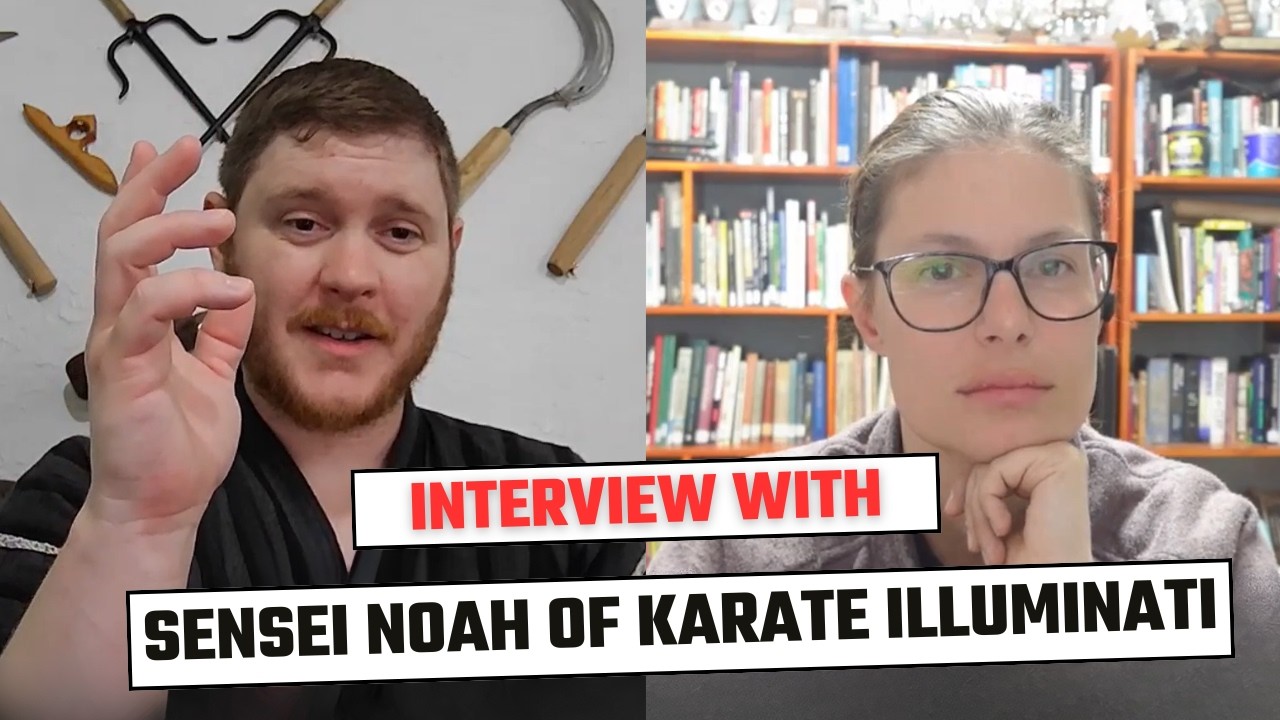
Karate Combat, Lineage and Legitimacy: an Interview with Sensei Noah Legal of @ilpracticalkarate
Onegaishimasu, welcome back to the Goju Ryu Karate Center. I have the great, great pleasure of hosting Sensei Noah. He is of the Karate Illuminati. I was very drawn to his work because of the way he’s prolific output on Facebook, on
Instagram, on TikTok. Would that did I could put out such incredible content all the time. I truly admire it. But also, Sensei Noah, and I think because you, like me, are not super traditional, your
lineage is really spectacular. You’ve got everything from Okinawan to modern. Will you please share your lineage and your experience with the Goju Ryu Karate centre
Writers’ viewers? Sure, so I got my start originally in Shuri-Ryu, which is an eclectic American style that
was created by Robert Trias. uh It is… Yeah. uh He’s a big deal in American karate for obvious reasons. uh And it is, although it is labeled as Okinawan karate, it is an American uh invention
that’s more or less a blend of Goju Kai, uh Shinto Jinen Ryu, and some material from various other places that he picked up along the way, plus his boxing and Judo experience. uh So I trained uh formally in a dojo in that system for about two years and I got to Sankyu
at the time and then I moved. uh Which relocating and getting a new job and everything else meant that I wasn’t able to
attend a karate dojo uh for about two more years after that. I started when I was 18 years old. uh I’m a late bloomer actually. no way because I also started in at 18, 19 So you’d look like someone who’s been training
since year five. Absolutely, never too late. So after the relocation, what was your next karate step? Well, I kept training on my own ah for about two years until my schedule was able to
change and I relocated again the place that was closer to Karate Dojo. But during those two years I also kept training in Judo. There was a Judo club that I was able to attend regularly. ah And I did a lot of research during those two years. ah lots and lots of research and just kind of connecting with people and that’s how I came to
realize that I wanted to learn uh older karate, something a little bit more classical in nature and I wanted to learn how to use it in a practical way. So that is what I started looking for. I decided I wanted to try Shorin-ryu if I could find it. So I looked around and there were two promising options. ah One of them became my late sensei. That was Richard Pogue. and he was a Shoren-kan, Shorin-ryu instructor. uh There are three main organizations from the senior students of Chibana Chosen who
founded Shorin-ryu, and the Shorenkan is one of them. uh And the other Shorin-ryu instructor in the area had the same lineage, actually, uh but
was a ninth dan from Okinawa. wow. it just so happened that he was farther away and the schedule wasn’t as good for me to be
able to make it to classes, so I figured, I’ll check out this American person first. And if I don’t like that, then I’ll make the other one work. But yeah, I went to Richard Pogue’s dojo, I watched a class, ah I sat and talked with him
for, I don’t know, an hour or two after class. And uh yeah, I was very quickly… Taken in by his ability his knowledge his openness his demeanor and Yeah, I started
training with him so ah I then took up Shorin-ryu uh Until his passing and then after but uh during that time I also switched from training in Judo regularly to training in Japanese
Jiu-Jitsu. That was one of the things that he had training in, so he taught classes on that for a
while. Eventually he ended up dropping those classes just because there wasn’t much interest in
them at the time, but uh probably another three or four years of Japanese Jiu-Jitsu. And uh in 2013 I informally started picking up Kishimoto-D, which is a rare Shuri-Te
system, basically a pre-corrupted Okinawan martial art ah and then I started formally training in that in 2014. So that is under Ulf Carlsen who is the only person to have a Shihan license in that art
outside of Okinawa. And ah yeah basically I’ve just been sort of blending everything together as I’ve gone on. I still claim Shorinryu as my core system. uh Kishimoto-di I tend to teach separately so that I can preserve that particular art since
it is so rare and at risk of dying out. Shorin-ryu isn’t at risk of dying out. Not too worried about that. uh And I’ve dabbled in various other arts attending seminars, know cross training sessions
sparring sessions uh with everybody from you know, other karate styles to kickboxing Muay Thai boxing wrestling Brazilian jiu-jitsu uh You name it. I’ve kind of had the chance to to train with or spar with some of these folks uh and over
the course of my martial arts career I’ve competed in karate of Submission Grappling and MMA. Wow, I have a very boring career, 20 years of Goju Ryu five or six years of Aikido and
judo when I was a kid. And all of that knowledge and all that experience, and you still come back to Shorinori. And the question I wanted to ask is, one of the questions I wanted to ask you is, how
important do you think lineage is now in 2025 with everything karate is facing both on and offline? Do you think lineage back to the homeland, back to Okinawa is still important? or do you think it’s becoming more more irrelevant? It’s important and it’s not. Right there are different there are different aspects of it that have value in in
differing degrees so on the one hand your lineage tells a story of how the karate got to you and It gives you an idea of the Methodologies that you’re more likely to have picked
up along the way right? Having a lineage from Itosu Anko. We know that he developed karate for the okinawan school system. He made it publicly accessible he reformatted a lot of it. created a bunch of new kata. Anybody whose lineage connects back to Itosu, we know that. ah And then… After that, we have all these stories and interviews. We know that, okay, well, this person was particularly good at uh using toe kicks. This person was really, really strong. This guy could hit really hard. This guy was really good at joint locks. There are all these sort of different aspects that different people over the course of
time preferred about how they would train and teach karate. And so that lineage tells you that story and it can tell you what type of material you’re likely to be training, the uh emphasis that you’re likely to
be looking at when you’re training. uh Some of the specific methodologies and philosophies, right? Things like Chibana Choson said that you should have three to five applications for every
movement in your kata. Well, not everybody has that kind of mentality, right? Some people don’t care at all. So… in that sense, in that historical telling the story of what material you have inherited,
there’s value to that. But as far as like having to have this pure lineage back to Okinawa in order to be
considered a legitimate karate practitioner, I don’t think so. uh There was a time when that was important, or in the early days of karate leaving
Okinawa, you had to have some connection to Okinawa, otherwise how were you learning it? Right? But at this point, we have people all over the world who have been training their entire
lives. ah There are some of them who have actually legitimately inherited systems from Okinawa. ah There are people who are incredibly high ranks that people on Okinawa consider to be
better authorities than some of the people in Okinawa. So I think it’s been disseminated well enough that having that connection back is nice,
right? And it’s nice to be able to go to Okinawa and go to the Honbu Dojo for your system and
train there with the people who’ve been training it for generations. And that’s very cool. But I don’t think it’s necessarily so vital to validating somebody’s martial arts experience. I think that’s really important to bring up, in the sense that American karate is, a lot
of people look at karate as a monolith, and it’s not. Karate is incredibly nuanced. It’s been fractured all over the world. And I think with America becoming the second kind of birth place of karate with the GIs
leaving Okinawa, lineage was very, very important back then. But now, as we’re seeing on the internet with all these discussions, I have… I love my lineage. I have a very strong lineage straight back to Chojun Miyagi Sensei children. And I’m like you say, I’ve never thought of it as a story to inherit, but that’s a
beautiful way of putting it. But as I become more mature and I understand more my karate, realized that lineage alone
is not enough. A lot of people have great lineage and terrible karate. It’s not like a magic elixir that’s going to give you magical, beautiful karate on the on
its own but it helps with the foundation. And on that topic, why do you think, or if you agree with me, that karate is having a
little bit of a legitimacy crisis at the moment? That only BJJ works and only MMA works. we’re kind of being forced to see in your comments as in mine, we’re always kind of having
to defend karate. We had a bit of a moment with Cobra Kai, but that’s over now. And now we’re back to defending our art. How do you think this came to be, the karate has, you know Like one of your videos, has got a bad rap or seen as impractical, inherently impractical
when anyone who studies it knows it isn’t. The issue that karate has with its reputation uh really stems from two sources. One of them is self-created, for sure. uh The other one is an external source of this issue. So on the one hand, a lot of karate schools uh did pick up the mcdojo uh format of running
schools and teaching uh that was developed in taekwondo. That isn’t a karate invention, but karate did take that methodology because it makes
money. you know, especially in America, there is a big drive to take anything that you’re
passionate about and use it to make money. uh And so that money-making drive pushed a lot of people to adopt that McDojo format, and
so they’re charging a lot of fees, they’re putting people into locked-in contracts, they’re finding ways to nickel and dime their students, and they’re not particularly
worried about teaching good karate. And so that has resulted in a watering down of the art in general and a lot of people
having this experience with that kind of karate because it’s very easy to, you know, spread your school around when it makes a lot of money. You can open up a bunch of different franchises and therefore you get more students in
there. And they may only train for six months, but they have that particular experience of karate
and their, you know, parents and family members see this experience as well. so they get this idea of what karate is in their head. That maybe isn’t accurate, but it is popular. And then from the external side of things, we’ve got primarily the mixed martial arts
community, both uh fans and practitioners of mixed martial arts. uh Over the past several decades, there’s been a really strong push to delegitimize traditional martial arts in that community. ah stems from the fact that when the UFC was originally created by the Gracies to showcase
Brazilian Jiu-Jitsu, uh there were a couple of karate practitioners in there and they didn’t do that great. uh One or two of them did all right, but overall they didn’t do very well and didn’t, you
know, win the tournaments that were being put on. And those handful of examples were extrapolated out to basically be representative of all
karate and say that, karate doesn’t actually work. uh And obviously we know that’s not true and there have been plenty of uh high profile MMA
fighters since that time who are karate practitioners and have done quite well. uh But the fact that the UFC was invented to essentially be propaganda for BJJ uh sort of set this in motion and got people talking about it in that way. And there has been a push ever since then in the MMA community to say traditional martial
arts don’t work. If you want to be able to be a good MMA fighter or defend yourself, don’t bother with
those. Train the big four, right? Boxing, wrestling, ue tai, jiu jitsu. Don’t worry about any of the other traditional martial arts. They suck. They don’t work. And that all… obviously stems from ignorance, right? They don’t know anything, really, about these martial arts that they’re seeing. insecurity. There’s insecurity because at the end of the we’re all competing for the same students. You know, if you want your MMA place to grow, you’ve got to prove that you’re better than
the traditional dojo down the road that’s been there for 20, 30 years. Like our dojo is turning 50 in three years. Anyone who comes into the area has got to decide, okay, tradition is the way of the past. The only new way to do it is the cool. I don’t know when MMA is going to stop being the new kid on the block when it has been here for like 20, 40 years. I’m waiting. It’s like the Holden Caulfield of martial arts right now from Catcher in The Rye And you
know, I don’t think the problem is as much, yes, with the practitioners to an extent, but I think the fans are actually much worse. I did a live stream this morning. I had an MMA fan up in my grill. So, you know, that’s what they do. They feel like they have to go and defend MMA like it’s an entity. in every single commentary on every single traditional channel. like, so what are you doing here? you hate watching karate? I don’t get it. But I think the way you put it, you know, that they had to de-legitimize karate. Even though there’s space under the sun for all of us, there’s enough space for everyone. You throw a rock and get 200 students in a big city. Yeah, and it’s not like I dislike MMA. I think MMA is great. I enjoy watching it. Like I said, I fought in MMA myself. uh And the big four arts that are popular and have become sort of the standard training
methods for MMA, they’re good. Boxing, wrestling, Muay Thai, jiu-jitsu, they’re good martial arts. I don’t have any problem with them. But my issue is that… They still have this us-versus-them mentality that came from those early UFC matches that
were intended to be style versus style. They ignore the fact that it was purposely formatted to let BJJ win more often. They avoid discussing the fact that that’s how the brackets were set up to try and make
sure that the people with good grappling didn’t necessarily end up fighting the Gracies. ah So it’s a disingenuous example of style versus style, but they still have that
mentality that MMA is proof that, you know, those traditional martial arts don’t work and only these do. And I guess they feel like they would be somehow lesser if they admitted that traditional
martial arts have some value to them uh even in a mixed martial arts context. But yeah, it’s definitely more the fans than the practitioners and when it is the
practitioners more often than not it is the uh the less experienced ones. uh The people who have you know some actual fights under their belt have a tendency to be
a little bit more open in my experience anyway. And I’m related to that topic. What do you think of karate combat? It’s like a… Oh shoot. I’ve watched a couple of matches. It’s a little bit gimmicky for me. The whole point was kind of to showcase the best of karate, know, character, integrity,
power, efficacy. And instead we’re getting like Bitcoin and weird graphics and a very bizarre ring and gold
pants. So… I really loved the idea. was actually really hoping that we could have our own platform to showcase karate that
wasn’t play, play, sports karate WKF. I’m sure you remember the debacle at the Olympics when the guy got disqualified. was the only time I was actually embarrassed to be a karate person was after the Olympics
because it just showed how ridiculous the rules are. And I was hoping karate combat could be our UFC and our platform. It’s still around, so it must be. successful to an extent. But what are your views on that as an alternative or as a legitimate expression of karate? ah I am controversially not a fan of karate combat. So I understand its intent, right? ah But it’s no longer fulfilling that intent. The reason that it was created was, like you said, to showcase karate in a full contact
format. ah And they did have a little bit of a gimmick with that pit design. But, you know, that’s alright. That’s a kind of fun, different way of uh restraining the fighters to a particular area. But, initially when they created this thing, you had to be a karate black belt to fight. That was how it worked. ah And as I recall, it was invitation only originally. ah think. There was like an auditioning thing at one stage. A couple of the people here were like, I’m like, sweetie, you’re not going all the way to
the States to give away to this taste. Yeah, but the thing about it is They’re acting as if it’s this, you know brand new idea um
It’s really just American kickboxing again If you’ve ever watched American kickboxing from the 70s and 80s like if you’ve watched Benny the jet, uh Urquidez fight, for example It’s
essentially the same rule set um they opened it up to allow more leg kicks and they allowed that little bit of ground and
pound. Those things weren’t really allowed in American kickboxing. But in the heyday of American kickboxing, ah obviously punches and kicks of all kinds of
different types were allowed and throws and sweeps were allowed in American kickboxing. in our kata Oh, well, yeah, in America. But for us, I think that’s the thing. A of people don’t know. They’re like, there’s no sweeps in karate. There’s no throws in karate. There’s no locks in karate. Not in my karate. My karate’s got all of those things. You just have to know where to look. And if your sensei shows you the way and leads bunkai first rather than kata first, then
yes, you will know these things. And that’s, I think, one of reasons why it’s very frustrating that karate combat doesn’t
showcase that stuff as much. It’s basically American kickboxing oxy. I would have loved to have seen it. Sorry, no, I interrupted. boxing 2.0 ah You know, they took American kickboxing They allowed a couple more leg kicks
and they allowed some ground and pound, but it’s still American kickboxing Which is based on karate American kickboxing came from karate practitioners uh But it came from karate
practitioners who were doing point fighting which was uh invented based on kendo. It was not actually designed for karate. It was based on fighting somebody with a bamboo sword. That’s why it’s the hit them once and you stop. If I have a sword and I hit you once, we’re probably done. So it makes sense in a kendo perspective. m Even down to the sweeps and throws that were allowed in point fighting, those were
allowed in kendo. uh Most of them aren’t anymore. Kendo’s reformatted their the rule sets. But back in the 1950s when they were developing the fighting system for karate, those things were allowed in kendo. So basically when they invented American kickboxing, they took point fighting and said,
well let’s stop doing the stopping thing and do it full contact continuous. uh Most of us at this point know judo to some degree, so we’ll add some sweeps and throws
in there. uh But that is such a small collection of material from the broader curriculum of karate uh That it just isn’t
representative of karate so That’s kind of the issue that I have with most sport karate formats uh They are all designed based on that original kendo idea essentially for the
most part They’re all based on this longer range, striking focused fighting. When karate is really a blended grappling and striking art, so it doesn’t make sense to
set yourself back to long range and just do punches and kicks. And then as far as Karate Combat combat specifically, they’ve… done away with the requirement that you are a karate practitioner entirely, and they’re
letting anybody from any striking martial art join in. And we’re seeing these people win championships who have absolutely no karate background. And I think that is just a major reinforcement of the fact that it is not designed for
karate. Because if it were a fighting rule set that was actually designed around karate, people
who don’t do karate would struggle to win championships. But as it is, it’s just basic kickboxing. So karate people, taekwondo people, muay thai people, uh kickboxers, whether they be
American, Japanese or Dutch kickboxers, all these different people can join in and have just as much chance of success because they’re all effectively training largely the same
material because that’s just kickboxing. And if it were designed for karate, then that wouldn’t be happening. And that’s kind of my big sticking point with karate combat. It’s fine. You know, I like watching kickboxing on occasion, but it isn’t representative of karate. And it’s kind of unfortunate that it’s taken the stage as the sort of default. ah This is this is how you prove whether your karate is good or not. uh Yeah, I think that Kake Dameshi would be a much better competitive format, personally. So explain that format to me because I’d love to learn what that is. My next question was going to be, so what would be the ideal fighting format for us to
really test? I mean, at the moment, so we used to have popularly in South Africa, we have a colloquial
term called “moer-mekaar” which is basically smash and punch. And they would put the very heavy protective gear on and there’d be two refs with counters
and just quack, quack, quack. They just keep tapping every time someone landed a hit. And then at the end, they’d see who hit the most and that would be the winner. And it was a lot more like, it was brutal. The one mask we have in the dojo is actually dented over the eyes because they just used
to hit the head so often. And it’s there like a suit of armor. No one wears it because, you know, there’s probably blood inside there. But so tell me about the format that you, you, uh, Takenma? Takenma dashi? Haki Bameshi. Okay. Kaka Dameshi uh basically translates to a test of hanging or hooked hands. And there are a couple different ways to perform this practice. One of them is actually one that you see present in a Bruce Lee movie. If you’ve ever seen the movie where they’re having this sort of tournament setting and
they cross wrists with each other and then they try to hit each other first. uh That is one of the formats that people can do for Kake Dameshi. And basically the idea is from touching you have to do whatever techniques you want do and generally get there before your partner does. That’s not the type that I prefer personally because that’s really just emphasizing fast
striking more than anything. You can do joint locks and takedowns and such as well but strikes are going to be faster
and if that’s what you’re kind of looking for then that’s a little bit more restricted. uh What I prefer doing uh is a bit more free form and a little bit more true to the
description that we of Kakedameshi from Nagamine Shoshin, the founder of Matsubayashi-ryu. In his book, he describes Kakedameshi as being essentially a very aggressive form of
Chinese push hands competition, but where you are allowed to strike and you are allowed to twist the joints, you know, not just try to push each other out of a ring. You can throw each other. You can strike each other. You can joint lock each other. And so the way that I go about doing this is, okay, we’re going to have our hands up and going to touch our arms at the wrist. It doesn’t really matter if you’re inside or outside, you know, one of each, but you have
to maintain at least one point of contact with your partner at all times. So you are required to stay at that arm’s reach distance. and you are allowed to strike, you are allowed to do joint locks, are allowed to do
sweeps, throws, takedowns, strangleholds, you name it, if it’s in karate you can use it. ah Obviously we make considerations for safety in training. You know, if you’re going to do something that would be attacking the eye, let’s put the
thumb on the eyebrow instead of actually putting it in the eye. If you’re going to attack the throat, let’s just kind of go towards it rather than
actually attacking it directly. You know, if you’re going to put a joint lock on somebody, give them enough time to at least move with it, you know. And this format, because of the range that it forces you to be at, gives you the
opportunity to work your kata application. which is something that the vast majority of karate kumite sparring does not do because
again most people’s sparring is based on that kendo idea it’s that long range get in and hit them and get away and even when you’re looking at something like kyokushin which sort
of blended that idea with the irikumi go the uh in hard inside fighting of gojukai it’s still mostly striking And definitely very little grabbing generally in most of those, you know formats You’re
allowed to grab for two seconds and that’s about it. Whereas in kakedameshi, the meshi we’re going to be grabbing the entire time Right because
I want to maintain contact. So even if I’m punch you I’m going to grab on to you with one hand and I’m going to punch
you with the other hand right and Being at that distance, being forced to always have a point of contact with your partner,
ah and then emphasizing in your training that this is more than a kickboxing match, right? We teach you all these other techniques besides strikes. This is your opportunity to use them. So this sounds a lot like randori, which is a large part of our black belt grading and
syllabus. But I like the adding the condition for the competitive element of having the hand on the
other person. Last night, we were doing randori in the adult class. It was one of my fellow black belts. And we went to the ground. And he choked to me. And was fully within the range of what we do. And I think if someone had walked in, it would have been like, this doesn’t look like TV
karate. They weren’t all at a distance. There’s no flip over kicks. I had the kids after the finale of Cobra Kai ask me when we were going to learn the
tornado kick and the flying kick. Not if you want to pass your grading, sir. Let’s just fix the maegeri before we get to your spinning round kick. I really, really love that idea. I think my questions are going to be implemented. So. um Hojo undo! I see you’ve got your weapons on the wall there behind you. But I see in some of your videos, you’ve got awesome looking chishi Tell me about your
favorite hojo undo implements and why. uh My favorite is definitely the Chi-Ishi for sure. uh And for those who are unfamiliar, the Chi-Ishi, which is short for Chikara-Ishi or
Power Stone, uh generally call it a stone mallet because that’s closer to visually what it looks like. It’s a stone or concrete weight on the end of a stick. Very, very simple. You can make it for a dollar. ah But the fact that it’s cheap and easy to make means that it’s very accessible. Pretty much anyone can make one. ah So it’s a really easy way to get yourself into hojo undo which is supplementary
training for those who don’t know the definition, right? And it’s a very versatile tool. uh Because of the way leverage works, right? You can adjust the difficulty by where you grab on the handle. The closer you grab to the weight, the lighter it feels. The farther away you grab, the heavier it feels. You can move through many different kinds of movement patterns with it. You can make them heavier and just focus on the strength aspect. You can coordinate your breathing with these things. There’s just a lot of different exercises that you can do to keep things uh fresh, keep
them from getting boring uh and yeah you can just do all manner of different exercises with it. uh Kettlebells or ishi sashi stone locks are also good ah but yeah my favorite is
definitely the chi-ishi. I’d also have to say, chishi Chi is my number one. We actually teach it to the kids. have a 500 gram, which is like a one pound, like a little mini plate weight on a stick. And A, it teaches them the responsibility of using a tool, much like at some point you
have to learn how to use a knife, teaching them how to use the chishi Chi safely, working on their core strength, their shiko dachis teaching them how to look after your dojo
equipment. I actually love the chishi Chi in them. Our range in our dojo goes from the 500 grams which is one pound, right up to we have a 24
pound, 12 kilogram chishi which only likes three people in the dojo are strong enough to use. But I’m a massive fan of chishi and of hojo undo in general. And think that’s one of the great gifts given to us over essentially the centuries,
alongside the makiwara. I think me and the makiwara have a love-hate relationship. Kongo-ken. wonderful implement but I don’t think it’s as versatile as a chishi. sheet. The weight stays the same, you can’t really adjust the weight and they’re very difficult
to come by. You can make your own, I’ve seen people make their own with conduit and sand or conduit
and cement but to have a true heavyweight kongoken cane I think is very very difficult and it’s inaccessible for most practitioners. Chishi is, is, you know. very easily accessible. Kongoken is not. uh Kongoken, of course, for those who don’t know, is a big iron loop uh or steel loop. Generally, you’re going to make it out of inch and a half to two inch uh diameter steel
tubing. And it’s usually filled with sand, steel bearings, something to add weight to it. uh I have two of them. I have one that I made out of PVC and cement and then one that I got from a dojo that
closed. is proper steel tubing but it is hollow so it’s not super heavy and you’re right not not
terribly uh versatile either it’s a good tool if you have one or want to make one i i encourage people to do so but i i would say that that’s definitely further down the line
than making chi-ishi uh but yeah hojo undo is is one of those things that a lot of modern karate-ka cut don’t do and there is still this idea that, you know, lifting weights is going to make you bulky and
slow and inflexible for a lot of people, which is not true. I think that’s been debunked thoroughly for a long time now, but there are still people
who are kind of telling their students that and it gives people this idea. And a lot of people just you like they’ll become bulky which is not true either. Yeah, well, I mean, a lot of people underestimate the difficulty of building muscle as
well. You know, they act like you’re going to get bulky like this on accident, you know, ah but
it’s not an easy thing to put on that amount of muscle anyway. And you are going to get way more benefit out of strength training than you are not
strength training. it’s going to improve your karate and it’s part of the tradition of karate to do these
strength and conditioning exercises. uh If you’re not doing hojo undo are you really doing traditional karate? Because you’ve dropped an entire segment of the art. It’s a quick way when you walk into a dojo to see how traditional they are. There’s no kongokens, there’s no makiwara, there’s no chishi I mean, that’s fine. You can be a super, super kumite-focused dojo. mean, if teaching good karate, people love karate and benefit. Great. But you can’t really call yourself traditional Okinawan karate dojo. You can’t put that on the door but not have a single chishi inside. So the funny thing is South Africa is oddly a goju ryu stronghold. outside of Okinawa. We’ve got some of the highest ranked Goju women and men outside of Okinawa here in South
Africa because during the 70s and 80s and 90s, it was very affordable for us to bring instructors over there for months at a time. And they would love to come here. We have a very big meat-eating culture, just the way we host. So they would really love to come here. And so we ended up developing this really strong and Goju Ryu community as well as an incredibly strong Shotokan community as well. you know, we’re talking hundreds of dojos, hundreds of Shotokan dojos in South Africa
alone. Goju has very strong lineage here. And I think one of the things is that we are trying to preserve. So we started our YouTube channel, The Lockdown Thing, because as a we needed to something
to give our students when we couldn’t teach them. But also what it’s become is a way to preserve knowledge. So as I’m sure you’ve seen my husband that trained with Sensei at Teruo Chinen and we’re
trying to preserve his teachings. mean, the internet could disappear. That’s why books are better. But it’s so much easier to make a video than to write a book and get it published. And leading into that, my next question for you was as a karate and martial arts content
creator, what do you hope will be your contribution And what have you found in your journey creating online? Obviously, we are now the vanguard of this. are kind of leading karate. I’ve been thinking about this a lot. know, feminism’s had a second and now we’re kind of in our third wave. And I feel like karate’s now about to enter another wave. You know, it was born in, well, everyone can argue about when it was born. And then our second wave when it left Okinawa and it left Japan. And I think now we’re heading into a third wave with incredible hyper spreading. Now anyone can put up content, and now anyone can call each other out. I think that’s one of the things that maybe the worst thing for most McDojos now is that
you can be called out. People can read Google reviews. But my husband was telling me in the 80s, you could get away with terrible karate because
it was only really word of mouth and newspaper ads. And no one could afford a TV ad. But now, so we’re living in this very fragmented, hyper-stimulated, for lack of a better
word, it’s just so noisy. And as content creators, I feel like we do have a duty to produce good quality content
that is accurate and educational. But you and I know we’re not creating particularly click-baity content. I was going through your library. There’s more content there than I can eat in a lifetime. And there’s so much I want to learn. You don’t have the viewers you deserve. You should be at 50,000 60,000 subscribers. But we’re not producing like super polished click-bait content. But I think we both have a role to play in that. How do you see your karate, the online legacy, and what you have to leave and what you
hope to create? And what example you’re hoping to set? And especially in the very wild, wild west of American karate? My main thing is just trying to help more people Understand and have access to the broader
scope of what karate is My late sensei and I co-created a YouTube series called Waza which was very popular while we were doing it that ran for about three years and The whole idea that we had behind that was, well, people have this particular idea of what
karate does. And we know different. We know it’s not just long range kickboxing. So let’s show people what it does. And we mostly focused on bunkai. We did some hojo undo things here and there. We did some sport fighting things here and there. But we mostly focused on kata application. And his idea was he just wants more people to learn what karate is really like. And I very much took after that mentality. having more engagement is great, having more followers is great because it helps more
people get that content and have access to that sort of knowledge because that’s just not necessarily available everywhere in person. Because like I mentioned earlier with the popularity of the McDojo format, most of the
schools that people have uh easy access to, they’re not really all that traditional. Or ah if they are, they’ve got a very narrow idea of what karate is because they’ve really
only experienced what they do and not what other people do. And… I also try to highlight the things that we have in common across different styles, as well
as the things that we have distinctly different and unique, because there’s value in both of those things. I think to say all karate is the same is obviously wrong, right? There’s a lot of uniqueness and… uh sort of different flair to different systems. But at the same time, we have a lot of things in common. And so we can celebrate the things we have in common and share the things that we don’t,
and it’ll enrich everyone’s experience. And that’s really what I hope to help people do. And that’s why I put out content that’s not only technique focused on how to do things,
how to interpret kata, but also things related to history and the philosophy of the art, because… It’s it is so much more than just how to fight. The fighting thing is the important but it’s not the whole of the thing. exactly. It is a martial art. You should be learning how to fight. You should be learning how to fight for a particular context. And if we are following the original intentions of karate, then those contexts should be
self-defense, law enforcement and security. Those are the things karate was designed for. So if you’re training for something else, that’s fine. But recognize that that’s not the intent of karate. You are doing something else with it. And, you know, like I said, if that’s what you want to do, that’s what you want to do. But there is a distinction between modern karate systems that are teaching you to compete. for example, versus classical karate systems that are trying to teach you how to
successfully defend yourself or arrest somebody or protect someone. And you can have crossover between those things. But you have to understand everything and where it came from to be able to effectively
communicate that, teach that, and have your students get out of the training what they’re meant to get out of it. actually leads me around to you as a sensei and as an instructor. we teach in our dojo we have an incredible range from five year olds to the youngest will
take and then right through to our oldest students at 68. And the difficulty is, you know, adjusting and scaling, goju ryu up and down depending on
who we’re teaching. But for the little ones, we don’t teach them randori Dory because we can’t tell them,
well, you can use a fishhook and then they have to go and fishhook their friends’ mouth. Now we get some, getting them to think of a thing. And we also want to teach, you know, how do you gouge someone’s eyes out because yes, it’s
in the kata, and how do you, and the chokes and everything that’s there. And so leading with that, I think, do you think that this movement towards, I’ve seen a
couple of videos now, I’m not going to mention them because some people don’t need the clout that karate takes too long to learn. Whereas I’m more like, how long is a piece of string? Because who are you teaching? You know, this idea that they must be, it takes five years to get a black belt or it takes
two years to get a black belt. It doesn’t make sense for me to admit if you are teaching karate as holistically as we are
because we are not here to produce elite athletes. The dojo had its stage, where my husband was a phenomenal coach, but those days are gone. And the dojo has grown since then because some people come to karate because of the vibes,
where people here just for vibes, they love it here. It’s great. They’re not going to be black belts They just want to come and have fun and see their
friends and kick a few things. And then you’ve got students with cerebral palsy and dyspraxia. We’ve got adults who are just stepping onto the mat in their 30s and 40s. We have teenagers who are full of like a vim and vigor. who also just want to smash something. So how do you mold karate for your students? What are your teaching principles? At least how you teach karate and chess. I always try to make sure that the way that I’m teaching people is suited to them
personally. That’s easier when you have fewer students, obviously. The larger your classes are, the less individualized you can make it. But… I do try to maintain an awareness of my students limitations and their preferences and
their goals. Goals are one of the things that I talk to my students about before they ever start
because I want to make sure that what they want to get out of martial arts is something that I can give them. If they’re wanting to compete in the WKF in the Olympics someday, I’m not the guy. So you have to have that conversation. all potential students know to ask about that or to even think of their goals they just
think I want to do karate or whatever ah but you you mentioned you know some people suggesting that karate takes too long to learn and it’s interesting for people to say that
because at the same time karate takes too long to learn but karate gives out black belts too easy that is a very popular right um and and the reason that they have that perspective is because they they sort of
misunderstand what black belt ranks are in karate versus what they are in something like bjj ah And BJJ has really influenced people’s perspective on belts since it became popular So
they’ve got this idea that a black belt is like you’ve you’ve become a master at using this art on people Because that’s BJJ uses it, you know That’s how Judo uses it as well. That’s not how it originally used it because it just created the black belt as the Kano
sensei can throw you you know how to breakfall black belt, but it became The students know who to ask for help. That’s basically why we started it. Because his dojo went from 50 to 120 overnight. He’s like, you wear a black belt, you wear a black belt. Everyone ask these two if you need anything. And these are my ukes. And we’ve kind of mysticized and romanticized what the black belt means. Rather than it being, you are a master of basics. Now we’re opening the karate buffet. Now you can start learning. more because now you master your basics, you can actually be trusted not to hurt yourself
or someone else. But you’re right, it’s both like this incredibly rarefied thing that only super strong,
super incredible athletes have, or it’s something that 10 year olds are running around with, when the truth is somewhere in the middle. Yeah, and and that’s the thing with the black belt is that in Japan and Okinawa a black
belt in karate is no big deal in most uh Most kids who graduate high school will have a black belt in either karate or judo uh Because those are popular PE programs and clubs
that they have and they’ll get it in three years Because it’s really only Meant to represent. Okay, you’ve learned all the basics of the system You’ve got a solid understanding of how
to move like we move uh So here’s your black belt now, you can actually start getting in depth start learning more details and so on and then that got taken to the west after World War II and completely flipped around to be
something mystical because these GIs spent six, nine, twelve months on Okinawa or in Japan and were given a black belt in that amount of time with the understanding that they’d come
back and keep training, which some of them didn’t do. But yeah, they got this black belt in six months to a year. But it’s going to take them four years before they can get back to Okinawa. So they need to drag this out. And so they start telling their students that it’s good, you know, it takes this long and
it’s this difficult thing. And that’s really why that got inflated was so that these people who got their black belt
in a super fast way can make themselves look better. Hey, it takes five years to get a black belt, but I did it in one. And then you also have the fact that they needed to stretch out this curriculum to bridge the gap between their visits to Japan. uh there’s always going to be a change in the way things are perceived over time. And like it or not, BJJ has influenced that too. And so it’s made the black belt this representation of mastery, which is not what
karate… and purple bouts are kind of like hardcore because of BJJ. I’m like, no man, kids have blue bouts. Plus. and on the flip side, though, there is something to be said for. the effectiveness of a practitioner in a certain amount of time. Because that’s the part where people are saying karate takes too long to learn. So yeah, it takes too little time to get a black belt, but it takes too long of a time to
become a good fighter is the thought process, right? uh Because most people will say, well, you can go train Muay Thai for nine months and beat
a black belt in karate in a fight. Well, some of them you can, not all of them. Yeah. But there is something to be said for the fact that many karate curriculum are fairly
large and they are purposely distributed across a large number of ranks and meant to take a decent amount of time to learn. uh And a lot of these schools also focus so much on the aesthetics of making it look
correct uh rather than the function of making it work correctly. Whereas if you’re looking at something like BJJ or Judo, their measure of your proficiency
is your ability to use the art on another person. Whereas the measure of proficiency in karate is very often how good it looks. ah Which is not Yeah, how how clean is your kata how sharp or are your kihon? ah You know, but that does not that does not actually Equate to the ability to use the art
That’s where the disconnect is. So you’ve got a black belt that means less than a black belt in BJJ, but at the same time by the time someone earns their black belt in karate, they maybe have the applicable
knowledge of somebody with much less experience in another art because of the way that a lot of modern karate is taught. uh And I can’t fault them for that belief because that is a popular experience for people
uh in karate. They’ve experienced that strip mall, McDojo, and… uh or even a traditional school, it’s a traditional modernized system like Shotokan, where
their exposure to the broader curriculum of karate is going to be limited. No matter how legitimate the style of Shotokan is or the organization they’re in, can be
very solid. Yeah, it can be very solid, legitimate Shotokan. But you have to understand that Shotokan removed the grappling material intentionally from
karate and they invented long-range karate that did not exist. And most of them have dropped hojo undo as well, right? ah And so the type of karate experience you have in Shotokan is very different from what
you have in Goju Ryu or Shoryu Ryu. even though they’re related. Yeah, I mean, they’re cousins. At one point, they all came from the same family tree. But you know, like cousins, they go off on their own journeys. And you know, one of the other things, and I don’t think a lot of people know this
history, is there was a very political decision when karate was starting to become exported as a soft power, as a kind of soft export from Japan, that karate wouldn’t really
trade on the toes of the jiu-jitsu. So there would be a, this is the grappling one, this is the striking one, and never shall
the twain meet. easier to export very simple things. And they were like, it’s OK, the people at home back know, but let’s see what we send to
the gaijin Visiting Okinawa was a bit like going to Mecca. And I love it. I can’t wait to go back. I absolutely adore Okinawa, the people, the karate, the dojos. It’s much more relaxed than I thought it would be. we have a very, because of, again, the strong shotokan influence on all karate in South
Africa, we can be very Japanese, more Japanese than the Japanese. you know, the obsession with lines and strictness You know, must be on time, to be late is
death and… And then when we arrived to Okinawa, they were like class starts at like 8.30-ish. We weren’t expecting that. It was so lovely to see them slow down. But also you could see the longevity. They train for longevity. They train for, I mean, you also see 80-year-olds hitting the makiwara and that thing
bends over Because they’ve trained. And that’s what I think a lot of these other arts are forgetting and not seeing. Karate is for life. For me, it’s for life. Not for everyone. I agree, some people it’s going to be like a six month chapter in their life. They go to a strip dojo, they go to the wrong dojo and they just have a bad experience and
that’s it for them. Or they’re with us for five years, but they move away or they get injured or life changes
and parents get divorced. You know, you only have that time with them. Okay, so like the 3 % of us who are in karate is a livelihood, a way of life, a way of
expressing ourselves, for me, my katas are my feminine expression of myself. I hate dancing. I’ll die before I dance in public, but I’ll do a kata on the internet. And I think that a lot of people don’t see karate for the longevity that you can train for
a long time and be strong and have that, also the mental strength and the midline crossing and building grey matter. I think that’s something that we like to emphasize on our channel. People are like, wow, you should punch sand and punch rocks. I’m like, First of all, I’m a knowledge worker. These hands go, I can’t run the business. I can’t be punching sand and rocks and have my fingernails going black and falling off. I did that once with ultra marathon running in my toenail fell off and I hated it. Once was enough. But I think part of what we get to do as content creators is very, yes, sometimes it sucks
to be a person on the internet because everyone has an opinion on the internet and opinions are like assholes. Everyone has one and most people are of shit. Part of the education that we get to do is telling people actually karate is so much more
than what you’ve seen on TV, on WKF, that random dojo is doing demonstrations, down at the mall. more. Like, it’s such a beautiful, multifaceted art. And I love that your dojo badge has got the shuhari translated into English. So for our viewers, I love that choice. Tell us about it. so Shu-Ha-Ri is an educational uh concept essentially of the process of how someone learns
something. You’ve got the Shu phase which is the copy or protect phase of learning. You are going to do something exactly as you’ve been shown. You are going to uh copy essentially what you’re being shown and do it exactly that way. really easy way to look at this is when you’re learning to write. uh They’ve got, you know, the paper with the lines on it, then you’re supposed to, there’s
a A written on the paper, you write an A, try and make it match, right? That is the shoe phase, the copy or protect phase. You’re protecting the tradition uh by learning it exactly as it’s being shown to you. Then, We go into the ha phase, which is the phase of uh evolution and uh adaptation, alteration,
right? This is where you make it your own, in a sense. You figure out the ways that work better for you and give it your own flair. So this is when you have developed your own signature handwriting style, right? uh And then we go from Shu and Ha into Ri, which is the transcend phase. uh This is the phase where you’re actually creating your own material, in a sense, uh and
you are extrapolating from what you’ve learned to come up with new things. And that doesn’t fit the handwriting analogy quite as well, because it just gets more into
the language, right? And as you go through and you’re writing, naturally, sometimes you’ll uh do a cursive letter when you meant to do a print letter and you’ll ah you know you’ll change the
grammar of a sentence to make it more your own there there are more linguistics involved because it’s a more uh natural thing to you it’s just something you do at that point and
it comes from an innate sense of understanding and this this process is something you can apply universally to anything that you’re learning. ah But I find that a lot of people mistakenly look at Shu Ha Ri as a linear process that
happens over the course of your entire martial arts career. So they’ll say things like, for the first five years of your training, you’re in the Shu
phase, you’re copying exactly. And then for the next five years, you’re in the Ha phase. And then the next five, you go into the Ri phase. And that’s just not how it works. The Shu Ha Ri process is a continual cycle that you go through. as you learn more about what you’re doing. You know, if you think about something you learned early on… You initially copied it and did exactly as you were told, and then you kind of figured out
your own way of doing it that felt better for you. And then you started extrapolating from that and doing more things with it. And then usually at some point you circle back around because somebody gives you a
correction or a new idea or asks a new question and you completely reevaluate everything. And it’s something that you do with everything you learn, not just over the course of your
career, but with every single component of learn. That’s really the best way of putting it, that we think, I saw one metaphor, we think it’s
a circle, but actually it’s more like a spiraling staircase. That we keep re-refreshing and going over our knowledge. And when I explain it to the kids, Shuhari it’s like, you know no one becomes cake boss
immediately, you start off making cookies. And once you can make cookies, then we can graduate to cakes. And eventually when you’re really good, you can be like, Heston Blumenthal or that crazy guy who makes amazing things out of chocolate. I’m sure you’ve seen the shorts on YouTube. He’s got a Netflix series called School of Chocolate. The stuff he comes up with is incredible. And that’s someone who’s still working with the same materials everyone else is working
with chocolate. But he is doing things with chocolate that normal people cannot conceive of. He is so far into “ri” that, you know, he’s gone off into the horizon and he’s setting an
incredible standard and a new school. But most of us, and then here comes the question, when are you allowed? Because there’s also this other problem now with this very conservative and rigid kind of
structure that we’ve unfortunately inherited. don’t know how much in America, but in South Africa it’s very much like you must stay
within these blocks or you will upset someone And that’s as much as I’m going say, or I’m going to get into big trouble. But like, I’ve been in karate for 20 years now. When do I get to have my signature and my stamp? If not after 20 years, when? But I still get kind of trimmed back into line because this is the one true way. Instead of, when does it get to be my karate, expressing my body and my wonky hips, but
also my flair and my understanding. So again, the contention and the difficulty of a very hierarchical structure comes back
into play there. I was lucky in that my late sensei was very big on trying to get his students to be better
than him. That was his goal, right? He wanted his students to be better and more knowledgeable than he was. ah None of us got there before he passed away, but that’s what his goal was. And he encouraged all of us to try to find our own interpretations and our own adaptations
for things as we would go along. And he would give advice, you know, he’d see us working on something and trying things out
and he’d be like, okay, well, if you tweak this this way, if you adjust this, you know, that might work better for you. Try it out. And he guided us through that process, but he encouraged us to constantly be figuring things out for ourselves. That was something that not everybody gets in their karate experience. uh And America tends to be a very individualistic society, uh and there is a big emphasis
on just the individual doing the best for the individual. uh But when it comes to traditional karate, a lot of people have maintained a more
Japanese… uh structure to that, especially because so many of the people who brought it were military. So they also are used to that rigid structure of the military. And so uh a lot of them do not really give you the room to ask the questions and figure
out your own interpretations of things. So it can be pretty hit or miss, but I would say that a lot of uh especially the the older
dojo that have been around for decades are more likely to have that mentality. um And a lot of them are more along the lines of, you can start making it your own after
you’re fifth dan or seventh dan of been, yeah, that’s when you get to be a real martial artist. Only when you’ve done your time, paid your metaphorical school fees, how many black belts
have you produced, have you done any research? And absolutely, but there’s also some people who just want to do karate until they die and
be happy doing this and that’s fine. And there has to be more, there have to be more pathways for people in karate. And, you know, if you try to create more instructors, not — Very few people are cut out to be instructors. But you know, I know you’ve got a private lesson coming up and I’ve so enjoyed talking to
you and I know I might have to let you go sometime soon. But I just want to say that I love the work you’re doing and I’m grateful that we live in
an age where there are practitioners like you who are flying the flag for traditional karate. And I think that’s also another reason why we need this third wave. We need a new generation of fresh blood, bringing new ideas into karate, better ways to
teach karate, better ways to preserve students’ health and student welfare. how we can run our dojos, how we can help everyone feel like they have a place on the mat,
under the sun. And I think you’re doing an amazing job of leading that charge. And keep up your amazing work for what is worth from a random third dan from South Africa. I love your work and I really hope to keep seeing you produce content. Thank you very much. appreciate you having me on. Awesome. Everyone, will put all of Noah’s links in the description. He’s got a huge prolific library of videos to watch to keep you company. He’s got books as well, which I’ll also link to. And I hope that we will maybe have another conversation like this again. I still have some things we can chat about. And we’ll definitely do it again. And we’ll do it soon. Noah, thank you so much for your time. Arigato gozaimasu. oh Very dark, cold winter’s evening. Wishing you all the best and good luck with all your private lessons to come and for your
karate until I meet again online. Thank you very much. Fantastic. Cheers. It’s been so lovely talking to you. Ciao ciao
Is a traditional lineage important? Is Karate Combat our UFC? What is your goal as a karate content creator? And why does karate have such a bad reputation now?
I chatted to Sensei Noah about all of these topics and more, learning tons along the way and thoroughly enjoying the sheer depth of Noah’s knowledge about traditional karate.
Find @ilpracticalkarate here: https://ilpracticalkarate.com/
His socials:
https://www.instagram.com/ilpracticalkarate/
https://www.facebook.com/ilpracticalkarate
@karateilluminati
And his helpful explainer of kakedameshi here: https://purokarate.com.br/en/2021/08/31/article-kake-kumite-kakedameshi-the-original-free-sparring-of-karate/
Chapters:
00:00 – Intro
00:32 – Sensei Noah’s lineage and background
06:14 – How important is lineage in karate today?
10:33 – Is Karate having a legitimacy crisis?
17:41 – What do you think about Karate Combat?
25:25 – Kakedameshi as the better karate fighting format
30:27 – Our favourite hojo undo tools
37:30 – What is your purpose as a karate content creator?
46:21 – The perceptions and problems with black belts
54:27 – Karate as a lifelong journey
57:07 – Shuhari as a process for karate and life
Join this channel to get access to perks:
https://www.youtube.com/channel/UCy61L8jq6ugyEwGNwMdVZhA/join
Our videos are free, but not cheap to make! Please consider subscribing, and get new videos most Fridays. We also have the option of Super Thank Yous, which is like a tip jar for creators like us. Think of it as buying a coffee for Zoe when she edits 😉
Find us online!
https://www.grkc1978.com/
https://www.facebook.com/GojuRyuKarateCentre
https://www.instagram.com/gojuryukaratecentre/
Mailbag: dojo@grkc1978.com
Video produced by:
Zoe Jagger-Hinis
https://zoehinis.com/
NPBHUB.COM | The Fanbase of Nippon Baseball & Nippon Professional Baseball